
According to a recent Harvard Study of 3 May 2022, about a quarter of school heads plan on resigning this year following the last two stressful years of leadership in schools and I would suggest, moreover in international school leadership. https://www.gse.harvard.edu/news/uk/22/05/stressed-superintendents-time-covid
Fear, uncertainty, second-guessing decisions, teacher shortages, the constant need for emotional support for staff, students and parents, lack of funding, parental, peer and student pressure, racial and national polarisation, political corruption, civil unrest, war, migration and the demand to be continually proactive created a perfect storm for school leadership. The study proposes action aimed at mitigating the effects of the last few years. These include the suggestion that school heads seek out support networks and partnerships to counteract the isolation that school leaders often experience. In international education this is further exacerbated in areas of the world where there are few international school and colleges environments. The study further recommends that individuals identify their growth areas and challenges and use this insight to develop further self-knowledge. A supportive partner and/or unconditionally loving pet are cited as important in the process and the practice of school leadership; few have either or both.
The process of schooling for international school leaders continues to challenge us, and the big questions and small wonderings continue to be very present.
Conrad Hughes[1] poses the following questions;
- Where do we come from and where are we going?
- What should we do to our children and to ourselves to ensure that the lives they and we lead are productive, happy, beautiful and purposeful?
- How do we carry the cultural and intellectual legacy of ten thousand years of history on our fragile shoulders?
- How do we ensure that young people carry the past into the present?
- How do we prepare young people for the opportunities, openings, extraordinary diversity, threats and challenges of our time?
Despite the huge changes in every corner of the world in the past 20+ years of this century, education has remained relatively unchanged. Even a global pandemic has not made a significant impact on the way we “do” education. If the experience of the external forces of the past two and a half years has not yet provoked a revolution in education that some of us crave, the fault lines rest within us all.
The movement of these deep fault lines within our earth, causing the plates to shift and the earth to move in ways that force us to rebuild and restructure our lives, may also be present in our world of schooling forcing us to think, act and be in novel ways. Volatility, uncertainty, complexity and ambiguity (VUCA) together with increasing wealth and poverty, internal and external insecurity, scarcity and abundance continue the polarization of the world in which diversity of thought, ideas and action are ever more necessary. Ignoring all this is no longer an option if we want to continue to be relevant to our youth.
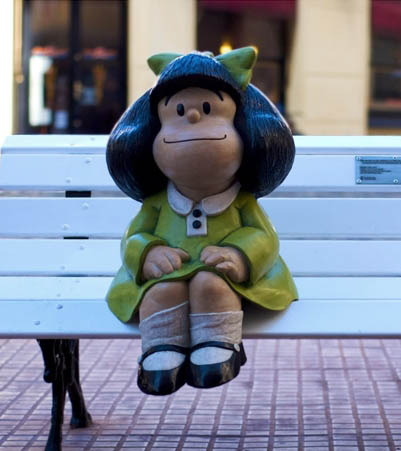
I wonder what Quino’s Mafalda would think of the world today. As the 6-year old character in the famous comic strip published in Argentina between 1964 and 1973, Mafalda continuously asked probing questions around the socio-political world of the decade. She was often pessimistic about the future whilst as she highlighted the cowardice of adults to take the bold decisions necessary. At one stage in her internal interrogation and analysis of the world of the 60s in which ideologies of communism were seen as a threat to the western world and dominated much of the adult conversation she cried; Stop the world! I want to get off.
This is reminiscent of the hopelessness that many of our young people in schools perceive of their own futures and of the world in which they live. How can schools respond to the clamour of these young fertile minds to make schooling relevant to their present and futures, their happiness and their sense of purpose in the world today, so that their tomorrows may be filled with hope and a sense of fulfillment for themselves and their communities?
[1] Hughes, C. 2018. Educating for the twenty-first century: seven global challenges
 Patricia Angoy