
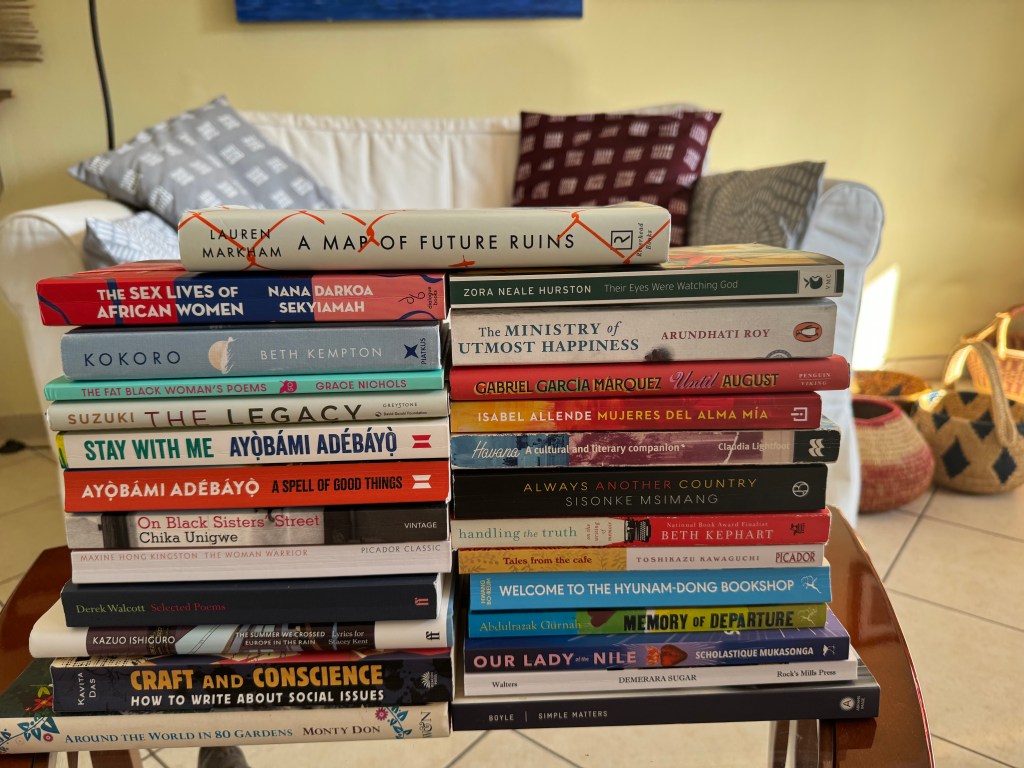
Emails, notes, academic reading texts, memorandums from various Ministries of Education, teacher appraisals, job descriptions, CVs, strategic plans, school accreditation documents, the odd poem from my desk, a light novel, the occasional can’t-be-put-down paperback, photography – gardening – recipes – interior decoration – art catalogues were the bread and butter of much of my reading over the last ten years, and mostly in English.
This beautiful time in my life has given me a summer to re-read a few of my old haunts from my book shelves and take deep dives into some new and wonderful prose and poetry from around the world and close to home. In the three months of summer, I stayed home, mostly, and read, read and then read some more. It has been the most wonderful holiday present to myself. I have had an opportunity to look inwards with the desire to understand what makes us human and so what may cause us to act in ways that dehumanise us so that we are no longer animal or vegetable. We become nothing.
I have been moved, once more, as I remember 30 years ago in Kigali, Rwanda, when reading Our Lady of the Nile by Scholastique Mukasonga, or the Nigerian Ayobami Adebayo, A Spell of Good Things and Stay with Me. I was online with Nana Darkoa Sekyiamah as she talked and answered questions around her ground breaking work of over a decade in The Sex Lives of African Women. The 2021 Nobel Laureate, Abdulrazak Gurnah’s Memory of Departure weaves together several beautiful and searing stories of the lives of those, still today, torn apart and brought together under colonial and neo-colonial rule. Pam Walters’ Demerara Sugar takes me home to the plantation life of the 1960s as I interweave her memoir, with the rich and lyrical poetry of Grace Nichols in The Fat Black Woman’s Poems, so reminiscent of women in Guyana and the diaspora. Derek Walcott, St. Lucia’s 1992 Nobel Laureate, sits on my beside table in the form of his Selected Poems. Sisonke Msimang’s Always Another Country, speaks to all of us who have moved too many times perhaps but hold onto family, the people, music, food and the vibes of our homelands. On Black Sisters’ Street by Chika Unigwe reminded me of the many winters I spent around the Gare in Luxembourg, handing out condoms, gels and wipes to the sex workers, leaving my day job as Principal at an international school every Wednesday or Thursday evening. That evening job, volunteering, was one of the most rewarding I have had; walking the late hours of the night among courageous women and mothers whose lives tell so much, untold and unwritten. Many of them remain in my heart as some ‘sisters’ I have most admired.
There are books that are part of my craft; Handling the Truth by Beth Kephart, Craft and Conscience; how to write about social issues by Kavitas Das and Simple Matters by Erin Boyle are all books this summer related to my own memoir writing and trying to live a life with simplicity. Around the World in 80 Gardens by Monty Don and Havana; a cultural and literary companion by my dear friend and colleague, now no longer with us, Claudia Lightfoot, bring to mind those incredible three years living in La Habana under Fidel Castro – an important part of my 30-year memoir which is a ‘work-in-progress’. We spent some of her last days together as I drove her through Havana and beyond. We got the chance to delve deep into many conversations around life in this unique city and also about the contradictions surrounding the marriage contract and how it has been so corrupted over the centuries.
The Canadian geneticist and environmentalist, David Suzuki, left me holding my breath listening to him at the Universidad de La Habana in April 2006, published one of his final lectures entitled The Legacy; his legacy for us all. Toshikazu Kawaguchi’s Tales from the Café, Kokoro by Beth Kempton and Welcome to the Hyunam-Dong Bookshop by Hwang Bo-Reum gave me a window into Japan and Korea. I wish they had been written when I was still an EAL teacher of Korean, Chinese and Japanese students – each culture, so very unique.Kazuo Ishiguro’s The Summer We Crossed Europe in the Rain is an interesting piece co-written with Stacey Kent and set to music by composer/bandleader Jim Tomlinson with illustrations by the Italian, Bianca Bagnarelli. 1982 Nobel Laureate, Gabriel García Márquez’s posthumously edited Until August is written through the eyes of a woman, and what a woman! Next month I have on the top of my list for autumn reads, A Map of Future Ruins; On Borders and Belonging, by Lauren Markham.
There are some women writers that I have gone back to this summer; Maxine Hong Kingston’s The Woman Warrior, the beautiful and brave Arundhati Roy’s The Ministry of Utmost Happiness, Isabel Allende’s Mujeres del Alma Mía, and the incomparable Zora Neale Hurston’s Their Eyes Were Watching God. This last novel of in the month of August, first published by Hurston in 1937, remains one of those in which I hang onto each word, each phrase, each sentence. As a photographer, film-maker, documentalist, poet and novelist, she is able to bring to the written prose, a deep understanding of what it is to be a black woman from the South at the time of emancipation through to the first part of the twentieth century. We see, hear, smell and feel each breath … still. Zora Neale Hurston ended her days in poverty but left us with so much of her work that remains today in museums, art galleries, bookshops and on film. She is in the air we breathe today. Her dreams remain those of many of us as black women more than one hundred years later
What reading fills your soul, your heart and your belly as summer draws to a close in the northern hemisphere and spring opens up to new growth and life in countries south of the equator?
P.S. You can probably get all these 26 titles on Amazon but I urge you to visit your local bookshop or library as an alternative and in support of our neighbourhoods and our authors. The big publishing houses and the online giant already have a stronghold – let’s make way for others.
Watch out for the close of the Luxembourg to Mpaka, Kamhlaba Challenge https://www.kamhlabachallenge.com/campaigns/from-luxembourg-to-mpaka
You travelled the long road with me and I am so very grateful to each one of you. There’s still time to make one last gift in September 2024 before I close the challenge that has enabled a full scholarship and medical insurance, examination fees, full boarding and tuition for a Mpaka refugee at Waterford Kamhlaba United World College of Southern Africa. Your generous contributions also guarantee her of a fully funded 4-year university scholarship in the USA on successful completion of her International Baccalaureate examinations. You have made a significant contributed to a 7-year educational journey. Thank you!
 Patricia Angoy
Thank you for this reflection your reflections on this topic really resonated with me, especially after reading Reader, Come Home: The Reading Brain in a Digital World by mary Ann Wolf and the importance of escaping to the realm of stories, literature and the written word.
LikeLike
Thank you so much for this reminder. Especially where we are constantly engaging in the digital world, like this. It is so freeing to be with words on paper.
LikeLike
i love reading your words Patricia… this one was quite some literary journey… and really resonates with me, as i too have spent time reading, reading differently for me… in the past 5 years following my retirement from academia. It is so liberating to read whatever one wants, whenever one wants
LikeLike
thanks for reading the blog Deborah. I too find it very liberating. I love the freedom of not having to, but wanting to. You know what that feels like, I’m sure. I have also discovered so much of what I enjoy, am moved by and I can enter into spaces that I have not experienced before, wanting them to last longer than the last page.
LikeLike
WOW!! This is incredible Patricia. “Your soul, belly and heart”. The message could have not been relayed any clearer. Ever since I arrived in America, I too, has been compelled to re-evaluate my sense of identity in this world. What truly feels my belly? how about my soul? Recently I read a “Token Black Girl” by Danielle Prescod and I was teared.I therefore realized that books do fill my belly, my soul and my heart.
Again, Siyabonga Kakhulu fore this masterpiece. It holds us together. I cannot wait for your memoir to be released!
LikeLike
… and I think reading helps me re-evaluate who I am and what I can do with what I have in my soul, my heart and my belly! I will check out your reference to “Token Black Girl”. I have certainly felt like one in my work over the years until I realised what I could do with that position. Siyabonga Francisco.
LikeLike
Thank you for sharing a wonderful book list…. I look forward to a summer of great reading and plenty fulfillment. I can’t wait.
LikeLike
Enjoy, Sibongile. As your summer approaches and ours, here in Luxembourg, comes to an end – this one anyway!
LikeLike
This post has caused me much reflection (a good thing!). I wrote in a recent publication how, as someone coming to terms with her lesbian identity in the 1970s, there were few novels available to give me a positive sense of my emerging identity (Carol, by Patricia Highsmith; The Well of Loneliness, by Radclyffe Hall). Thankfully this has changed over the decades and a book that I absolutely love for its blurring of boundaries racial, sexual, gendered, is Girl, Woman, Other, by Bernadine Evaristo. Other novels that have taught me about my colonial identity are The Poisonwood Bible, by Barbara Kingsolver (read on my first visit to West Africa in 2002), and The God of Small Things (read on my first visit to India in 2008). Reading outside my white, British heritage has been both a joy and a challenge to a narrow identity that has expanded as a result. Thank you!
LikeLike
Thank you for your most thoughtful and personal comment, Fran. Reading outside our heritage, whatever that may be, is so important I think. It helps me broaden my understanding of our shared humanity towards a growing appreciation of the multiplicity of my own identity.
LikeLike