
All That You Have Is Your Soul
Song by Tracy Chapman 1989
Oh my mama told me
‘Cause she say she learned the hard way
Say she want to spare the children
She say don’t give or sell your soul away
‘Cause all that you have is your soul
Don’t be tempted by the shiny apple
Don’t you eat of a bitter fruit
Hunger only for a taste of justice
Hunger only for a world of truth
‘Cause all that you have is your soul
….
A hope to dream a hope that I can sleep again
And wake in the world with a clear conscience and clean hands
‘Cause all that you have is your soul
Today will end. Wars fought now, around the world, will end. The humanitarian crisis in Haiti, Afghanistan, Sudan, the Democratic Republic of the Congo and the genocide in the Occupied Territory of Palestine, they will all end as we know them now. But … from the experience of our lives and those of the ancestors, something sinister is taking their place. It is inconceivable that the memory of the oppressor will not live on within those that survive, and also in those who have committed the atrocities we see, hear of and feel deeply. The latter will continue to defend their actions. So what do we do now?
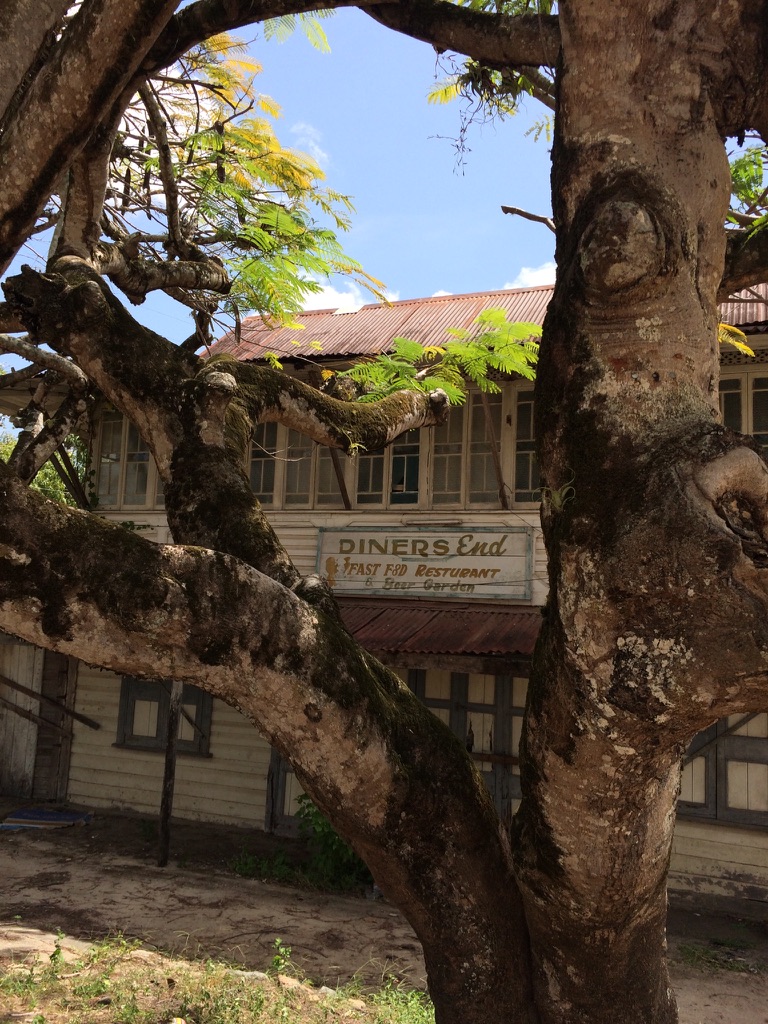
How do we see through the gnarled trees that still stand against all odds? Those green shoots that defy the laws of nature, without nourishment, they struggle and survive inspite of all that surrounds them? I took this photograph last year. The ‘diner’ no longer exists. Piece by piece, each wooden plank has rotted in the humidity of the tropics. Other stronger timber has been removed, sanded and provides shelter for families nearby. Window frames have been repurposed, brass door handles sold for a few dollars. Pipes, guttering and galvanised roof tops reused. But the tree still stands. The view between the two branches that stood strong for so many years has now disappeared. The soul of this tree, however, resists. So, how do we support our own souls through this time?
What can we learn from our diverse natural world; the epitome of both co-existence and dependancy that is mutually sustainable and has the ability to thrive; as do many rivers, forests, deserts, mountains, lakes, oceans and seas despite our disregard. Languages and ethnicities push against borders and the arbitrary idea of nationhood divides rather than unites. The colonial concept of north and south has no true basis but is maintained in a world that turns and evolves. On the rare occasions, I get to witness the murmuration of birds in synchronistic waves and sounds bringing thousands, and even millions of individuals together in one flight. Their patterns, in movement, take turns in leadership to allow for rest and recovery. How could we humans replicate this on earth?
How do we continue tomorrow, and the day after that?
and … How do they wake up each day “with a clear conscience and clean hands”?
What will we do with our souls?
 Patricia Angoy
“I get to witness the murmuration of birds in synchronistic waves and sounds bringing thousands, and even millions of individuals together in one flight”. What do we exactly do with our souls? When we know that even birds are doing much better than us yet we have exalted ourselves as superior to them? Patricia, when you describe how the tree lost everything yet still erect, I thought about a video I saw yesterday of survivors of rape in South Sudan yet we still ignore that. the soul suffers–we however, quickly ignore it because we ‘can’t do anything’. Sometimes, I have attempted to replace faces of these women and children with my mother and sisters and see if I see it differently. It is horrifying! The entrenched othering, that we cast when we view these videos or newsblogs, makes it ‘easy’ for us to ‘ignore’ it. Like you said; “It is inconceivable that the memory of the oppressor will not live on within those that survive”. And what about their souls. How about our souls and conscious that saw it all and looked the other way. What price do we exactly pay? We are surely selling our souls. Slowly eroding it!
LikeLike
Oh Francisco! You read so deeply into the writing. It brings the rawness of life and loss so close. Thank you for sharing your comments with me and others who are here to read them. Thank you!
LikeLike
Among the powerful images you mention, the murmuration of birds is indeed one of the clearest examples of what respectful and caring coexistence can produce (I love watching it). People often don’t realize that other living beings give us a masterclass in living harmoniously together every day. Nature thrives against all odds, perhaps because it never abandons its own essence to defend external, self-destructive interests. Thousands years later, we still have proof that it works, and yet we hardly try to learn from it.
LikeLike
… and often we don’t look up and around us to observe our natural surroundings that are so powerful. Thanks so much for your comments.
LikeLike
Thank you Sisi.
Lately, my days have become increasingly full, and it’s taking me longer to get through my emails. Still, I always make time to read your blogs—which I savour and enjoy. I really admire how starting from the title, your writing sparks reflection and deeper thinking—it always leaves me with something meaningful to ponder.
Hope you’re having an amazing summer.
Warm regards
Sibongile
LikeLike
Hello Sisi. Thanks for taking time out to share your comments. I really appreciate this gesture. Hope we can squeeze some time in for us to chat some more.
LikeLike