
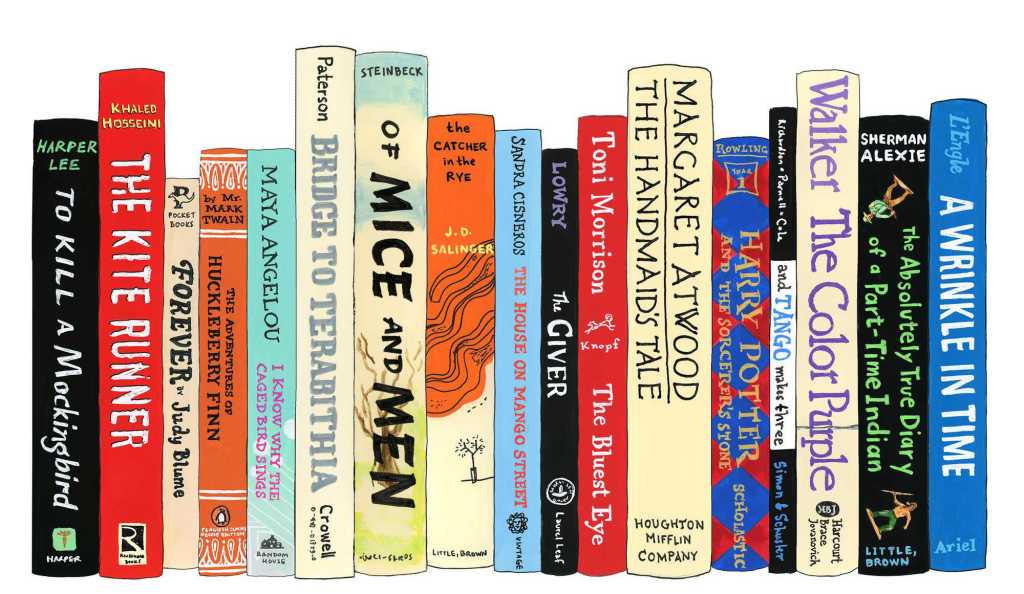
Photo credit: PBS illustration – Jane Mount
Thirteen years ago, Chimamanda Ngozi Adichie warned of the danger of the single story https://youtu.be/D9Ihs241zeg and earlier still, the great Nobel laureate Toni Morrison, through her published work, interviews and refusal to be silenced or misrepresented, reminds us of the master narrative, imposed from the time of slavery to the present day. This master narrative now tells a whole generation of young people what they can read and denies these fertile minds access to literature they deem inappropriate. Through the power of censorship, 32 states affecting more than 4 million students in the USA (figures: school year 2021-2022) have passed laws to withdraw nearly 2,000 book titles from libraries and classroom bookshelves. PEN America has deemed the banning of books in schools and libraries across an increasing number of states thus;
“… the resulting harm is widespread, affecting pedagogy and intellectual freedom and placing limits on the professional autonomy of school librarians and teachers. The repercussions extend further, however, to the well-being of the students affected by these bans. Children deserve to see themselves in books, and they deserve access to a diversity of stories and perspectives that help them understand and navigate the world around them. Public schools that ban books reflecting diverse identities risk creating an environment in which students feel excluded, with potentially profound effects on how students learn and become informed citizens in a pluralistic and diverse society.”
https://pen.org/report/banned-usa-growing-movement-to-censor-books-in-schools/#
The citation above represents only one country, and there are many more. Deliberately, through acts of law, or less overtly through high taxation, poor distribution, publishing restrictions and translations, to name a few, young people and adults are limited or denied access to a wide range of literature from all areas of the world and in multiple languages.
At a time of increasing erosion of our freedom to speak, to think, and to wonder –it seems to me that there is a slow culture of eradication in education and an implantation of methods, programmes, and acronyms that make empty gestures towards more inclusive schools and colleges whilst increasingly excluding diversity in thinking and access to languages with which to do so. The suppression of language is the repression of ideas, dialogue and dissent.
Hannah Arendt cautions against the suppression of ideas, and advocates for language that promotes thinking and seeing in our shared world, with all its plurality of viewpoints and expressions. Christiane Amanpour has taken a firm stand on the importance of truth over neutrality in a short excerpt from one of her many interviews on the subject of freedom of speech https://youtu.be/ciY-HkNe1cU. In denying young people access to books like; Gender Queer: A Memoir by Maia Kobabe, The Bluest Eye, by Toni Morrison, The Kite Runner by Khaled Hosseini and Out of Darkness by Ashley Hope Perez, to name only 4 of the 1,648 the banned titles in many districts and states of the USA as of 30 June 2022, this, in my opinion, constitutes an active attempt at erasure.
Language is our most powerful and unique way as human beings to think about our world and ourselves, within it. Without access to the literature, thoughts and ideas of others that provoke and stimulate our own understanding how, then, can we reimagine diversity, equity and justice for all in the places and spaces we inhabit?
I’d love to hear your thoughts and ideas. Drop me a line in the comment box below. Next blog post end of April!
 Patricia Angoy
Thank you for sharing this thought-provoking blog post. The issue of book banning and censorship in schools and libraries is a concerning issue that affects not only students but also society as a whole. As you have highlighted, literature plays a crucial role in shaping our understanding of the world and promoting diversity – censoring this is not the smartest move.
I agree that it is important to promote intellectual freedom and encourage a culture of open dialogue and critical thinking. It is only through exposure to diverse perspectives that we can develop a deeper understanding of ourselves and others.
Can’t wait for the next one! Cheers
LikeLike
Thank you so much for your deep reading and comment. Let’s raise our voices and speak! All the best Laurice.
LikeLike
Hello Ms Angoy!
This is a brilliant initiative, thank you for raising awareness to such an issue of global significance. As a student I relate to this as there have been times when I didn’t have access to literature in my curriculums from a diverse range of authors and I was never represented as a black female in a positive light. I hope as a society we can all be galvanized to create the positive change within our school libraries and curriculums so that all are represented equally and there is access to diverse literature. It really is a crucial part of identity formation amongst the youth.
Very inspiring!
Truly can’t wait for your April post!
LikeLike
Dear Chloe
Thank you so much for making such a valuable contribution through your comments. Hopefully you can request specific titles and encourage others to advocate for greater representation in our national, school and college libraries. Your experiences should not be perpetuated. Be well Chloe!
LikeLike
I could not agree more about the use of acronyms, and the move to empty gestures. Worse, I think the people who encourage and celebrate these empty gestures believe they are doing ‘enough’.
We take dangerous and courageous voices, ideas, and alternative perspectives and then repackage them and make them safe for ourselves…and if we cannot/will not, then we invalidate them, or ban them.
Perhaps by trying so hard to be ‘with’ the students we miss the perspective it comes from. Every time we reframe, we inadvertently (I would hope) remove it from the setting/experience which birthed it and we co-opt it through our own lens. One which fits our own terminology, our own experiences, our own world view.
I worry about the damage we cause our institutions through our ‘best intentions’.
LikeLike
Hi Simon,
Thank you so much for raising these thoughts. Your observations about our educational institutions are so important for us to face. I too worry about the damage caused through good intentions!
LikeLike
I think about all I didn’t learn in highschool and university and at times angered by my own ignorance. Realizing though that systems have been put in place to ensure the masses stay ignorant. We definitely need support systems for our young people outside the traditional education models.
America and these other countries are killing themselves
LikeLike
Hi Ché, now that we are parents we can try and redress our own experiences. Sometimes, inadvertently, I think some parents think the education of their children rests solely with the institution of schools and colleges. I believe we are all responsible.
LikeLike
Hey Ms. Angoy!
This was intriguing and it reminded me of a discussion we had in my Literature class on the ways that colonialism kept its structure in place and one of the ways was using the educational system. If you have not already read Decolonising the Mind by Ngugi wa Thiongo and Concerning Violence by Frantz Fanon, I think you would enjoy them as much as I did.
LikeLike
Dear Swelihle,
Thank you so much for engaging with the blog. Both Fanon and Ngugi wa Thiongo were very influential in my thinking as a student and young adult; still are. I am so grateful that you have the opportunity and responsibility to influence and be influenced in your thinking, especially at Waterford Kamhlaba! All the best!
LikeLike
Thank you for this thoughtful post and highlighting this issue. Reminds me of the Ray Bradbury book Fahrenheit 451 and François Truffaut film adaptation of the book. The parallels with this story are sobering as well as frightening in my opinion
LikeLike
Thank you, ‘Beyond Digital’ for engaging with my blog. Welcome!
LikeLike
Bonjour Patricia
Thank you so much for this thoughtful post. It reminded me of my second daughter, Jasmina taking on one her professors at LSE in London re the limited and exclusive list of books she had on offer touching on Africa’s post colonisation trajectory etc. Eventually the professor admitted her bias and welcomed new books Jasmina suggested for inclusion. This was not without the long process it took to get there…..
Jasmina and Yelena were later both involved in a movement at LSE and Brown in Providence USA respectively in a movement called “Why is my curriculum so White?”
I loved reading your contribution. Some of these issues are being felt in Francophone west Africa. There we do still need to go beyond sensing issues towards a more structured understanding of these, a lot of which are the basis of today’s soft powers. Your contribution is invaluable in that regard.
Pierre
LikeLike
Thank you for your contribution to the discussion, Pierre. There is so much work to be done and I am especially gratified to know that our young people, your daughters, are continuing to highlight the injustices whenever and wherever they occur. Merci.
LikeLike
My dear Patricia,
Thank you for the profound and provocative post. Why do we continue to allow for voices to be silenced and ignorance to remain?
Thank you!
LikeLike
I hope that with the work you do in education internationally, those voices will be heard and we will begin to learn and think compassionately. Thank you for taking the time to share with us.
LikeLike
Thanks for taking the time from your very busy life to read my posts. I really appreciate this Poala. Take care.
LikeLike
In the middle of all this grasping, click-baiting censorship, it’s hard to remember that autocrats, dictators and established religious structures regularly go after or suppress the artists when those entities feel their own vulnerability. This has something to do with recognizing that arts speak to people on profound psychic, intellectual and emotional levels that aren’t defined by a balance sheet. These organizations at once want to ‘have that’ and suppress ‘that’ for its population. I’ve lived in countries where visual artists are not allowed to display openly on the streets because the government fears political opposition, I live in a country where more and more, grant structures originally designed to support artists, have more and more adopted the language of corporatism, expecting the arts to develop performative material that either fits their corporate vision or gives the impression that the government is solving major human rights issues. Censorship is the other side of the coin of performative support and ultimately, a sign of their weakness: artists doing the hard work that leaders are not willing to do. I love the book Station 11 by Emily St John Mandel . This was published several years before the pandemic but is portentous of it. Like Fahrenheit 451 by Bradbury, it is the people who re-tell the stories without the normalized tools. In Station 11, it is a travelling troupe of Shakespearean actors who go from place to place enacting the truths through Shakespeare while the upheaval is occurring. I am a theatre person so of course, identify with that potential. Augusto Boal, all those years ago, developed the Theatre of the Oppressed under the most repressive of regimes. As we end this pandemic over the next couple of years, I believe all of us will need to do as Adichie, Amanapour and their like in our own ways, by demanding more of our leaders and structures. We will need to be brave and inventive in our strategies. I also think it will be a slow process.
LikeLike
Being brave and inventive is in our nature and I thank you, Vicki, for taking us through another area of the arts that continues to be under attack.
LikeLike