
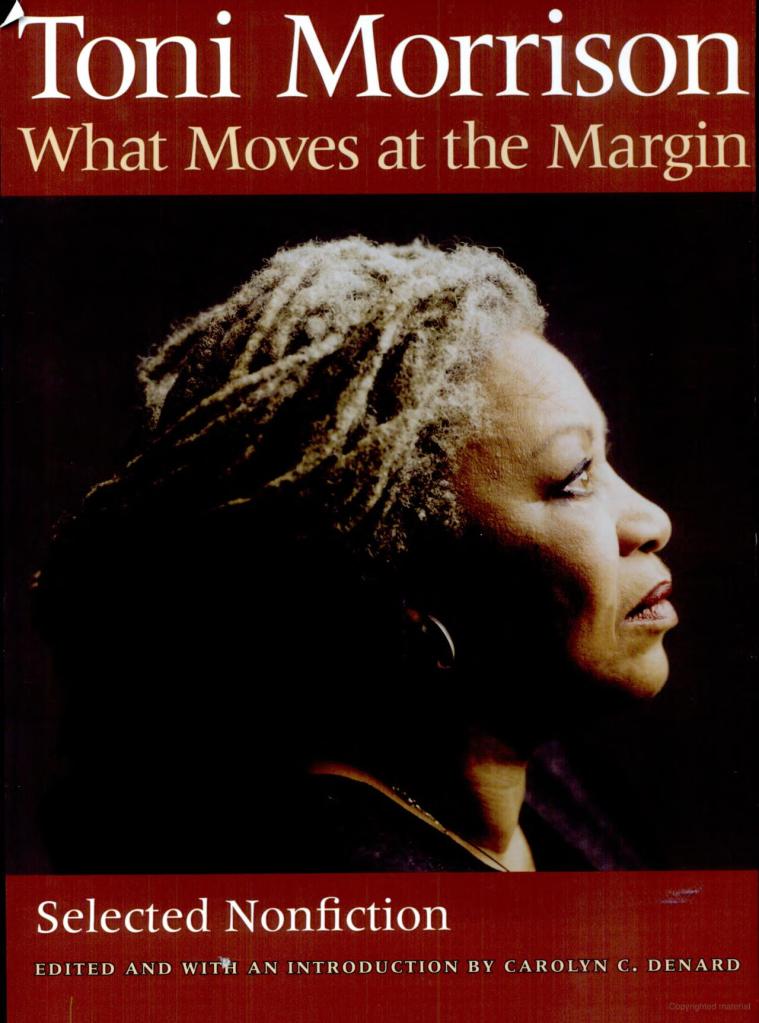
Photo credit: Toni Morrison by Timothy Greenfield-Sanders. Location on the shelves at the BNL: 81 MORR To: 1 w
In one of the closing paragraphs of Toni Morrison’s Nobel Lecture, as recipient of the Prize for Literature 30 years ago in December 1993, she talks of this place; the margin. This liminal space we once called home is now lodged in our imagination, and the buoy that kept us safe has been set adrift. The ability we have to envision, to ideate and to re-create ourselves through language is unique to our species and a gift to humanity; therein weave the treacherous with gilded hands.
Toni Morrison has made a craft and science of the English language through her essays, speeches, novels and her exploration of the writings of others. We see ourselves revealed, organised and set onto what was once a blank page. She holds the mirror that we are often afraid to reach for and look into, unashamedly and without a sideways glance.
This month as politicians, media gurus, shining tinsel of the small and big screen, mercenaries and ‘influencers’ cloud our minds and try to dictate our thoughts, form our ideas and move us to act in ways that go against every ounce of humanity, I am grateful to Toni Morrison who in her boldness and audacious beauty holds us to our truths.
I am grateful to our black writers who remind me of that place called home and to Morrison, in particular, who weaves her words as our ancestors did with messages of hope. They did so in braids of hair as they crossed over in slave ships to the Americas, in baskets with intricate geometric designs that predate modern mathematics and in beaded necklaces and bracelets as love letters. Toni Morrison, you help us rediscover our lives and the places, spaces and items that make up our experiences and contribute to our immortality.
I found this book of nonfiction writings covering a 30-year period 1971-2002, in the National Library of Luxembourg this month. The library, which opened in 2019 just before the Covid-19 pandemic, is a space on five floors, flooded with natural light from its central atrium. It is hugely popular with all generations, but especially with the young. There is room to study, discover and lose oneself freely in this beautiful environment. This month it honours the photography of black writers and thinkers of the 20th century.
There have always been examples of great libraries around the world that reach out to people. Every village, every township, every city, county and country in the world should have spaces in which we can “dance with the minds” of others and forge the justice and peace needed to be able to continue our futures. However, for that to happened we require leaders with thinking minds, willing to partner in the dance.
What moves at your margin?
Some interesting libraries at the margins
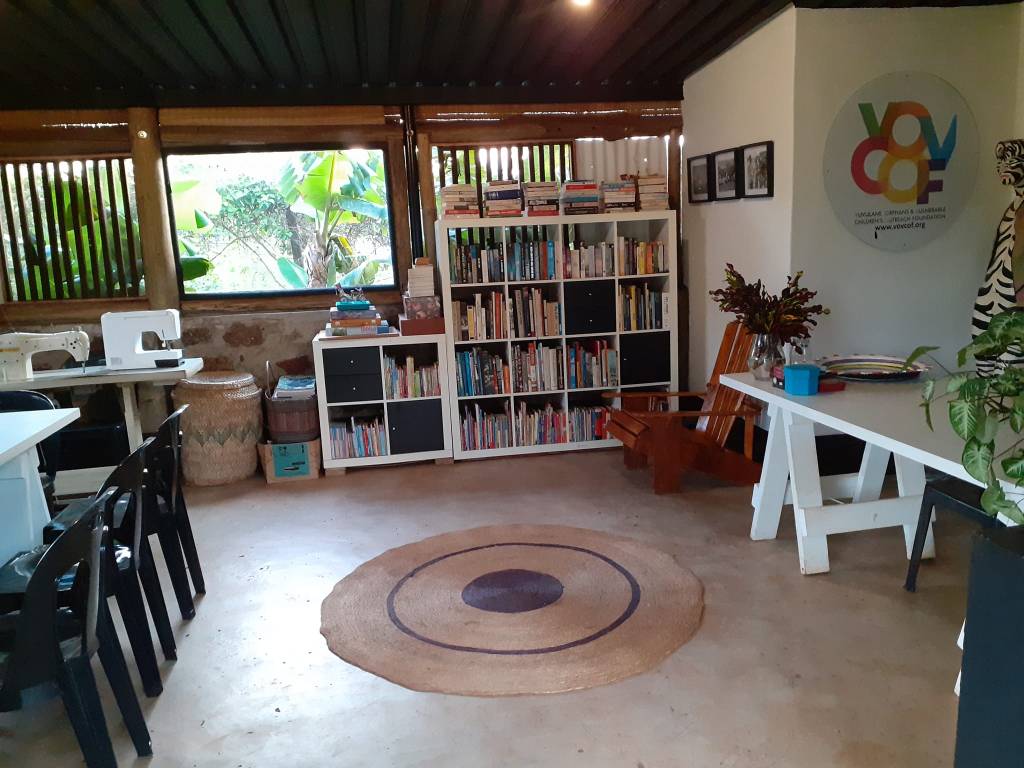
My dear friend Khulekani Msweli, in Vuvulante, Eswatini founded a youth centre in this small rural community, in honour of his father, Paul Msweli. In it there is a small library corner in one of the most beautiful and dignified centres I have encountered. Do visit and contribute to the foundation when you can. (Photo credit: Khulekani Msweli)
The donkey library of rural Colombia
https://www.bbc.com/culture/article/20180410-biblioburro-the-amazing-donkey-libraries-of-colombia
The camel mobile libraries for rural nomadic people of northern Kenya
https://www.theguardian.com/world/2005/dec/04/davidsmith.theobserver
Mexico City is said to house the biggest library– video tour
Dunga, Zanzibar the library created out of an old ship container
One of the largest great libraries of the world in Alexandria, Egypt was built somewhere between 285-245 BC
https://whc.unesco.org/en/tentativelists/1822/
One of the most beautiful libraries in India is the Sarasv(w)athi Mahal Library in Tanjore, Tamil Nadu.
https://indiaculture.gov.in/thanjavur-mah-serfojis-sarawswathi-mahal-library-thanjavur
My “local library”, the National Library of Luxembourg, which also funds the library bus that travels the country can be found here
———-
As always, if you would like to contribute to our Kamhlaba Challenge you can check it out here…
 Patricia Angoy
So much happens at the margins. Yesterday I was part of a focus group reflecting on a study of the ‘social justice sector’ in South Africa’s non-profit world, and we spoke of why activists from this sector have failed to halt the decline into corruption, maladministration, impoverishment, crime, and social disintegration. One of the abiding beliefs inherent in so much of current analysis is that change will come from the mainstream, the established ‘NGO’ movement, the middle classes, intelligentsia, intellectuals – people at the centre of media attention and public discourse. Nobody sees the resistance of those on the margin, who every day defend their dignity against the onslaught of a system that actively marginalises them, dehumanises them. Your thoughts on libraries on the margin resonates so with me. It captures the idea that there is infinite knowledge and wisdom there – indigenous, forged in resistance and struggle, beautiful in its solidarity with others. We would do well to visit these libraries – and the margins
LikeLike
Totally agree with your comment Ashley. That is why I wanted to highlight the work of Khulekani in Vuvulane and those of others elsewhere who open up spaces for other ideas and actions to flow. Thank you!
LikeLike
Me levanta y me nutre el alma tan profunda y sabia reflexión.
LikeLike
Gracias Marcela. Pronto haremos tiempo para las “sobre mesas” en Santiago con hartas momentos para hablar sobre el mundo.
LikeLike
Largas conversaciones tendremos,querida amiga.
LikeLike
Hello Patricia,
Last week I took my mother, her sister and my cousin to Jozini for a visit. It was great to have made time for them but the twins (my mother (83yrs) and her older sister (88yrs)) are a handful! They absolutely loved being there and to have the opportunity for a country break.
I had to research the title of this blog. It’s a very interesting way to describe events that took place in an era. It made me reflect as to what moves at the margin today. You ask a different question….what moves at your margin. Do I even know what moves at my margin. This months blog needs to discussion 😊
Warm regards
SG
LikeLike