
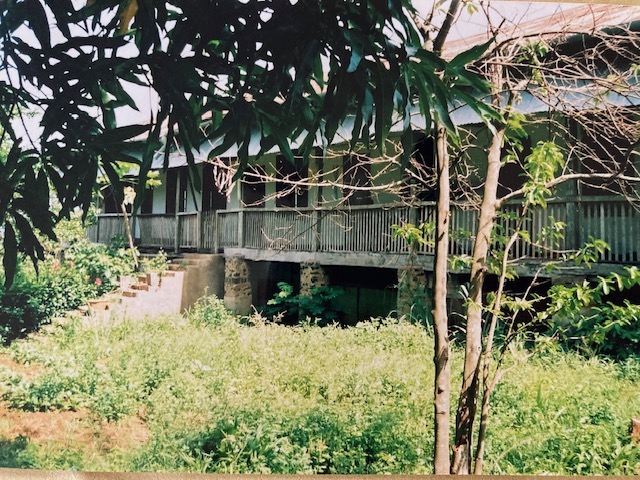
Photo credit: author
I am learning to look at what I can see in the images I have taken in the places I have lived.
From time to time, many of you will look at printed photographs you may have in old shoe boxes, as I do. Some of you may even be fortunate to have black and white pictures stuck on black porous paper engraved with white ink; each page covered with acid-free parchment. Others still, have theirs meticulously catalogued behind translucent sheets and numbered through the years. You may still ask yourself – where exactly was this taken? You may remember the country or the year. You may even remember the city, town or village … but the details of what has happened in this place, throughout time, may be lost to you.
I took this photograph in an abandoned village, north of Lomé in Togo, West Africa, 20 years ago. I was on a field trip with some IB DP (International Baccalaureate Diploma) students during their community service weekend. We had travelled north from the capital city on the dusty and pot-holed roads towards Kara. A turn off along a dirt path brought us to a clearing where a group of German missionary doctors and nurses had commandeered the local people to build their hospital during the 1930s. The advent of World War II meant that the medical personnel were interned and eventually the field hospital was left unattended and in ruins by the time we arrived there with students. There were rudimentary cots in bare rooms adjacent to the old hospital run by some Togolese missionaries. We were given a kerosene lamp – which I did not use – and access to a communal shower, that was operative only in the evenings, for a brief period. Long enough, however, to get rid of the red earth, sweat and dirt accumulated during the day’s trekking through the dense undergrowth around.
Most of my free time I spent reading, taking notes and walking through the undergrowth surrounding the partially overgrown hospital and outbuildings. I wondered what my Togolese hosts must think as they witnessed successive groups of young people from across the continents and their teachers use their space, eat from their trees, shrubs and harvested crops, use their water from the rivers, cook food that was foreign to their taste and eat together in the early evenings just before sundown. For most of us, there was no common language to use with the local hosts. French had been imposed by the most recent colonisers but most Togolese have managed to preserve their own languages, against all odds. In the Scramble for Africa, the British, the French, the Belgians, the Italians, the Portuguese, the Spaniards and Germans all had their share in carving-up Africa like a carcass of meat, taking choice parts to savour at will, leaving remnants of offal to be scattered throughout with no respect of the ancestral lands and rivers, tribal languages and ancient kingdoms. By 1914 over 90% of the continent was under colonial rule; from its 10% in 1870.
I now look at this Fuji-color photograph of the old hospital, crumbling and pulled back into the forest, with its own story buried along with the German doctors and nurses, set apart from the local patients in separate, but nearby, cemeteries. The tragedy of this photograph is that it is just one small example of the ways in which the European colonisers have gone into our lands, taken what they want, and more recently, often with the pretence of providing some humanitarian service then leave, with a lot more than can ever be ‘restored’. Copper, gold, diamonds, lithium and other minerals. Timber, coffee, cacao, cotton, tea and a continuous flow of produce northwards, west and east.
Mallence Bart-Williams at TEDxBerlin gave a powerful presentation on the colonial rape of the African continent with special reference to her homeland, Sierra Leone. I invite you to watch it in its entirety. https://youtu.be/VtYVqpylLhs?t=27m Ms Bart-Williams gives us a short geo-political lesson on “Where in the World?” like no other.
As I come to the end of July 2023, and the 60th Anniversary of Waterford Kamhlaba United World College of Southern Africa, my question this month is – Where in the world are you?
Kamhlaba Challenge
As usual, please do support my Kamhlaba Challenge to fund a refugee student at Waterford Kamhlaba. This challenge is already funding a young female student from the Mpaka Refugee Camp in eSwatini. At the end of a successful IB Diploma, she will be awarded a fully funded scholarship to study a 4-year undergraduate degree. Let’s help change the course of these bright young people. Click on the link below and make a difference now!
 Patricia Angoy
An excellent piece of writing Patty. Evoking all the right emotions, from a deep, deep sadness of the past, to the joy and hope for the future. Thank you for sharing.
LikeLike
Where in the world, indeed! That is a beautiful account, Patricia.
I have just released my second book, Fatback, Life in the Pocket. About my life in the music business, a much different read than my book about the TRAP program. I found many black & white photos in cabinets and shoe boxes, closets, and storage. It was fun, and the pictures were funny!
LikeLike
Hello Eddie, I will look out for your book and buy a copy. You have certainly made the difference to so many in the world! It is an honour to have worked with you, albeit briefly in Ecuador.
LikeLike
Well, Patricia,
One never knows when our paths may cross again.
And I hope they do!
With Love & Respect
Eddie
LikeLike