
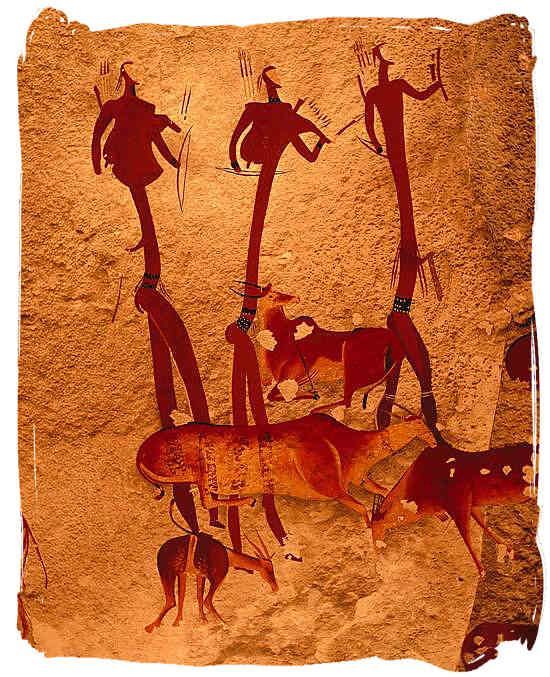
Credit: The San People of Southern Africa, 4000 years ago
This penultimate month of 2023 marks the end of schooling for many in the southern hemisphere. Graduation ceremonies evoke a plethora of emotions from students, their parents, teachers, and other members of staff that keep a school functioning and growing.
As young people finish their academic year, many will start a new journey of greater discovery that will last the rest of their lives. In the case of Waterford Kamhlaba United World College of Southern Africa, these Form 5 and IB2 students leave a place where living together, working, loving and longing created experiences of growth, awareness and commitment to a better world; one more just, more peaceful and one of greater understanding. A world in which the meaning of Kamhlaba – being of one world – became a lived experience. The concept of place, and its impact on our lives, is palpable at Waterford Kamhlaba.
Behailu Bekera, a WK UWCSA alum recently posted;
“The two years I spent at Waterford (UWC of Southern Africa) were the most challenging yet most rewarding, even surpassing my PhD in terms of preparation and personal growth.”
There are few on this earth that continue to stay in the same place, journeying only as far as they can walk, run, swim or paddle. And although many of us embrace the experiences learnt from our ancestors, the knowledge and spiritual connection they had to each other, the land, water and air, they too moved, migrated, travelled and made home somewhere far from the place of birth. This is especially true of students who are forced to migrate. Those who have become refugees without a passport and without a country, travelling as United Nations documented citizens of nowhere, seeking somewhere.
So … what do we leave when we leave somewhere that has enriched our lives, strengthened us, given us a safe haven, sheltered and loved us as we worked and lived among others different from ourselves? We may have experienced some hardships, struggles and a feeling of loneliness among a multitude. But we may also, if we were lucky, experienced what it means to be committed to an ideal greater than our individual selves that pushes us towards a future where we are required to understand who we are in the places we find ourselves.
As students and staff pack their bags this November and leave Waterford Kamhlaba, leave Mbabane in eSwatini, say their goodbyes to the place that was their home and make their way down the steep winding road that leads them away, no student, no employee leaves without allowing their invisible footprint to remain implanted into the soil. Like the early rock paintings found on the continent, depicted above, so too there will be invisible markings all over the campus to say;
“I was here”
What will newcomers find in the places you have left?
This month I celebrated the 60 years of Waterford Kamhlaba’s existence as a deliberately diverse, anti-apartheid college in Southern Africa, working together for justice. A small group of us, connected to the college, got together for breakfast at the Unicef Haus, in Luxembourg. You too can connect through the Luxembourg to Mpaka Challenge, wherever you are in the world and make a lasting difference to a refugee student. Join me in supporting the Kamhlaba Challenge.
 Patricia Angoy
What do leave when we leave? Or what do we truly call home. For some, it’s memories when they were silly and carefree. For some, it’s the reputable legacy that has been constructed. And for some it’s true PEOPLE they met. Waterford is a special place. It’s not just a stop-by or transit, it’s home. It is home because that’s where our hearts are. We ‘left’ it but who leaves home?
Thank you very much for this inspiring writing!
LikeLike
For me, I hope that when we leave a place, we leave it in a different and hopefully a better place… as undoubtedly, Patricia you did, both at ISL and Kamhlaba
LikeLike
What do we leave when we leave – my mind keeps being drawn to Cop 28!
LikeLike
So true Sibongile. Let’s hope that we can all think of what we do today will impact on the future of others.
LikeLike
Loved reading this as always the phrase “what do we leave when we leave somewhere that has enriched our lives, strengthened us, given us a safe haven, sheltered and loved us as we worked and lived among others different from ourselves?”really resonated with me, and has me thinking after leaving home here Nyon Switzerland in 1984 traveling the world for professional and further education reasons … you post has me thinking and reflecting thank you , A book you might enjoy connected to your post I think “In this distillation of reflections accumulated from a lifetime of travel, Ryszard Kapuscinski takes a fresh look at the Western idea of the Other. Looking at this concept through the lens of his own encounters in Africa, Asia and Latin America, and considering its formative significance for his own work, Kapuscinski traces how the West has understood the non-European from classical times to the present day.
LikeLike