
I found myself in the air I breathed from the moment I walked onto the tarmac from the plane. I found myself along the dusty road from Timehri Airport to Georgetown. I found myself in every street and around every corner, in and out of Stabroek and Bourda markets, by the sea wall, walking on the grassy verge of Anira Street where I grew up, and in and out of the houses with their jalousie shutters. My bare feet felt the cool polished hardwood floors beneath the ceiling fans and I drank water from the earthenware jugs in the kitchen. I strolled under the royal palms in the Botanical Gardens and sat in the shade of the hibiscus of the Promenade. The brisk winds from the sea wall, the Theatre Guild in Kingston where I had performed as a young girl, the familiarity of Lamaha Street in Queenstown and Moray House in Cummingsburg, all became a renewal of childhood memories in the present day. I found myself everywhere.
However, it was my visit to Berbice, the birthplace and boyhood terrain of my father and my grandfather, where I encountered my home. I am not sure for how long the Angoys had lived in this county, or where my specific origins date from slavery to abolition, nor can I mark the precise time when the family moved to the capital, Georgetown. What I do know, is that Berbice was always a place of return in my childhood years. As a family we would often rest at Government House on route to the coast and 63 Beach; in the days before fully paved roads, SUVs, hotels and restaurants at every village stop.
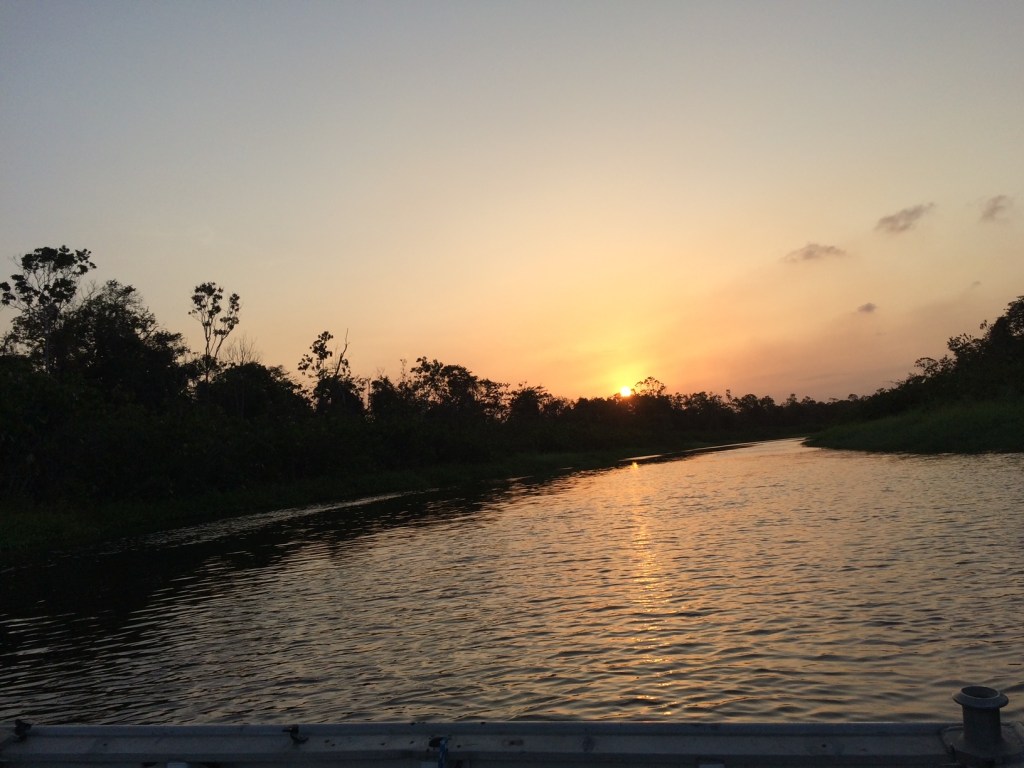
This time, I felt a renewed familiarity in each step, almost as if I had walked these paths many centuries before. I left land and ventured out onto the waters of the Berbice and Canje rivers. These are natural water channels that run some 70 -110 feet deep. Our flat-bottomed boat sped up the Canje, past mangroves and the sound of howler monkeys in the distance. Each diverse song from a myriad of tropical birds is recognisable by the local residents and indigenous peoples of the region. All along the banks of the river the famous Canje pheasant, our national bird better known around the world as the hoatzel, were grouped together in the low hanging trees. I was drawn further and further up river. The wide mouth of the Berbice and Canje rivers began to narrow and flow silently through the deep forest. River snakes, owls, thick undergrowth hiding small creeks of clear, dark, deep red-brown waters promised not only to quench my thirst but guarantee my return. The alligator slid into the water as we rushed past disturbing its late afternoon rest alongside the huge omnivorous manatee that surfaces very occasionally for air. Deep into the river the blood sucking mosquitoes hovered just above my head, together with the iridescent dragon flies that seemed to signal the way forward.
A little further up river was the place of the first ever major slave rebellion of 1763 that lasted over a year in which the black African slaves, captured on a continent thousands of kilometres away, brutalised but not dehumanised, rose up and fought for their freedom. As the boat slowly manoeuvred the twists and turns up river, with the increasing absence of any sign of human settlement along its banks, I sat in silent awe and with deep gratitude to my ancestors; the elders who gave their lives under backbreaking conditions of depravity so that I could be free.
I am deeply thankful to my ancestral family for their resistance and for their lives lived along these banks and within the dense forest. I am humbled by their strength and knowledge as they navigated these waters, toiled the land, fed their families, healed the sick with roots, bark, leaves and stems, sang, danced and learned to read and write. Still, they carried heirlooms in their hair and practiced the ways of life far away from their homeland. Their understanding of the importance of human bonds, of fighting for a future that they could not ever live to enjoy and to love the new land and make it home, was what I discovered in myself and felt run through my veins, likened to the water below me as I travelled up the Canje river that late February afternoon.
There is a profound change that took place within me that evening on the river. I sensed a connection with the elders but also with the water, the earth, the air, small plants and trees, animals of the land, water and air but more deeply to my people, buried in that undergrowth. My family can be traced back a few scant generations but I felt linked to a past much larger than my name, or the land I was rediscovering. My heart grew on that river, as did I. Going home after 30 years, brought me closer to who I am than any other experience to date. My journey continues.
What do you discover when you go home?
I am indebted to David, for safely driving the land with me, to Blackwater Adventures for skilfully navigating the waters and to the Post Girl in New Amsterdam for offering me her friendship, unreservedly. I was not alone.
 Patricia Angoy
Beautiful descriptions, Patricia which draw us into thinking about our own roots very strongly. Looking forward to hearing more about the visit
LikeLike
Patricia, I was awed by your heartfelt description of returning home. I felt I was traveling by your side, your beautiful prose transporting me.
I remember you fondly from the time we were in Chile.
Sue McDonald
LikeLike
Dear Sue, I too remember both you and Joe fondly. You are often present in my life, moreover now as I put pen to paper in some memoir writing. All the very best
LikeLike
Hello Sue,
I thought I had replied to you but it must have been in my head! Thank you so much for your thoughts here. I remember you and Joe with so much fondness and gratitude.
LikeLike
Hermoso relato de vida que muestra lo orgullosa que estás de tus raíces.
LikeLike
Patricia thanks for sharing your profound insights and experiences. This was very well written. ❤️👏🏽
LikeLike
what a beautiful, thought provoking piece Patricia.
LikeLike
Thanks Michaela
LikeLike
Thanks for reading my blog Anne and for your cherished comment.
LikeLike
This was a very moving read. I’m so glad your trip was such an opportunity for connection. Thank you for sharing
LikeLike
Dear Ruby, thank you for reading my blog and taking time out to comment. I really appreciate you.
LikeLike
I loved the story. You are a fantástic writer and you should continue with the rest of your life. Congratulations. 👍
LikeLike
Hello Patty, thank you so much for taking the time to read it and for your encouragement and support
LikeLike
Exquisite! Dear Patricia I read your blog over and over and each time found something new to ponder. So many questions like how do the alligator and manatee exist in the same river? How come I hadn’t really known details about your childhood and Guyana’s beauty as well as history before reading this marvel? It’s thoughtful and lovely and you’ve shared so much of yourself. Thank you for enriching our lives and giving so much to your students, teachers, friends, family throughout the years.
LikeLike
Thank you Patricia, for allowing me to accompany you on your journey back home. Beautiful account of where you feel you belong and to whom you belong to.
LikeLike
Thank you Wendy. You were so important during my time in eSwatini and so welcoming into your home. Belonging is everywhere and I am certainly enjoying these beautiful fields around my small home.
LikeLike
I strongly believe that, when you go home, whatever that might be, you find are pieces of yourself. Pieces and molecules that are building blocks of your identity. This reads like an attributory note—a recognition that honors the fortitude and resilience of your ancestors. Thank you very much for sharing this masterpiece and taking us with you on your trip!
LikeLike
I love the idea of finding “pieces of yourself” when we go home. It is so true. I could not have expressed it better than you have captured in this short comment. I love your prose as it so expresses what I felt on that Canje River.
LikeLike