
Sawubona – a greeting that met me each day on my way to work in Eswatini. A greeting that says much more than a “hello” or a “good morning”. One that recognises not only one’s existence but says powerfully, in just one word, I see you and I am happy that you are here. Most of the time, however, we are not seen, or only briefly acknowledged.
Similarly, erasure occurs not only with ourselves but with the books from our libraries and places of learning, our photographs from their frames in public places, our names as survivors of war, or as former enslaved people. Our homes and homelands have been razed and erased from maps and our very identities, as part of a common humanity, denied.
Imagine traveling across borders as a refugee, fleeing a place of conflict where a war is being raged. The aggressor has his own territory. He is not dependent on your resources yet he wants more, and more and more. Until you are no longer. We experience this in history, again and again and yet we cannot break the cycle of power and domination of one group over another. War, and particularly genocide, is an effort to erase the very existence of every child, every adult, every home, every school, every hospital, every blade of grass, all sources of energy, food and water. And yet, knowing all this, the genocide continues.
We have several examples of erasure at this present time that operate in other more subtle ways. In homes as one member of a family is not seen by others, in schools when we teach to a group without recognising individual talents and skills of each student. The continued erasure of women who work in sweat shops and factories producing cheap clothes that are later bought online and thrown away after one wearing at most, but often with their tags still intact, dangling from a string, as are the lives of their makers.
When the media floods us with images, some real and others AI generated, it is sometimes difficult for the unfocused eye to determine reality and we are swept into a world of make-believe and pretence, diverting us from seeing the machinations of the powerful and the real challenges we face ahead. When we train our eyes to focus on the individual maybe we can imagine the real generational damage being caused and continue to work actively to re-imagine other possibilities; together. Maybe when we look deeply for the magic each day brings where we can learn, think, create smaller worlds of difference that benefit each other and thereby secure a future in which we are seen.
Who do you see?
https://kunstmuseumbasel.ch/en/exhibitions/2024/when-we-see-us
Koyo Kouoh, who died this month, curated the exhibition of black art in When We See Us, a celebration of over a century of black figuration in painting. A celebration of one woman’s vision to give visibility to those unseen. What will we be commemorating in 100 years from now? What will May 2125 look like through the eyes of those yet to be born?
What will they say about us, as individuals, as groups, as nation states? Where will we find the societies who can wake each day and say, Sawubona, to a neighbour in passing, with the weight of meaning that the greeting holds? How do we bear witness now, to our ancestors, the gogos, our grandparents and our people?
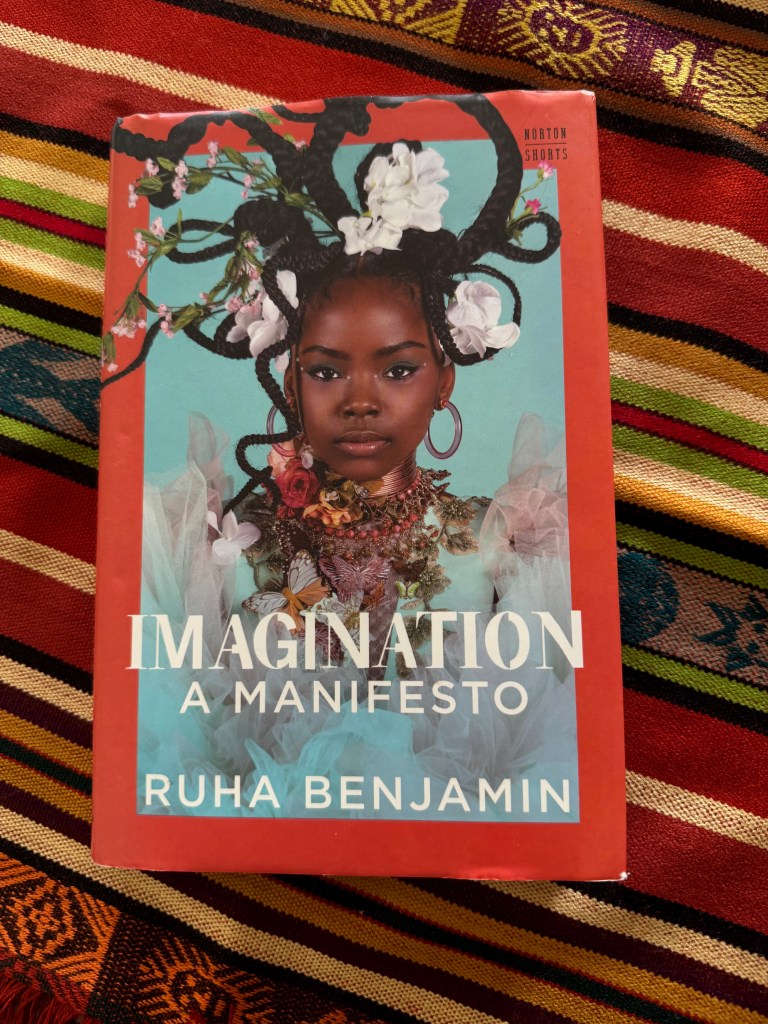
Surely, we can imagine a different future, even for the next five years. Ruha Benjamin continues to help me see behind the images that flash onto my screen, that are printed in newspapers and magazines, that are present in every item of clothing I buy, in every plate of food that I eat, in the buses I ride, in the home I live in and in the land on which I walk and the air I breathe. Those individuals who participate in providing me with a life I can enjoy, the books I can read, the music I listen to and the company I keep. I say to each of you; Sawubona. But none of this is a given.
Five years ago, I stepped in as director of an international school in May 2020. The previous decade had been marked by conflict and erasure in almost every country in the world. These were turbulent years as young people, displaced people, under-represented people, tried desperately to find a place in the world where they could be seen and heard. As the group of over a hundred 18-year-olds walked across the stage, one by one, to collect their diplomas, without being embraced, without the handshake, without the cheers and roars of their peers, teachers, parents and friends, one student knelt before his group instead, raised his fist in salute and was seen. In doing so he not only recognised the brutal murder of George Floyd but that of hundreds, thousands, millions who have died under the unseen force of another human being.
Five years on, the ING night marathon will run this weekend in Luxembourg, where I live. 17,000 will attempt the course and there will be those of African heritage who will be at the forefront of the winners of the gruelling race through the city. There will also be those in pink, running for their lives as they battle against breast cancer; on the rise all over the western world.
Good luck tonight as you run the 5k, the half marathon or each step of the 42.2 km (26.1 miles) tonight! Sawubona sista. I see you, I recognise you, I acknowledge you and I respect you here, in this moment.
 Patricia Angoy
“Until you are no longer”. This phrase is very powerful. In this polarized world, there are those who do not ‘deserve’ to be seen and those who ‘must’ be seen. In America, when you meet an African American person, at airports and trains, they affectionately say “What up brother?” & “I see you!”. There is a recognition. I see you. Some sense of solidarity. It has always made my day. Being seen is powerful as it shows that you matter. You are here and your presence matters. Thank you very much for these thought-provoking articles as always Patricia.
LikeLike
Until you are no longer! That too lends to much weight to the meeting. I cannot agree with you more, Francisco. Walk well and safely in this world. Until we meet again, Sawubona!
LikeLike
In a world, where some lives matter more than others – where some are not even seen, I see you Sawubona.
LikeLike