
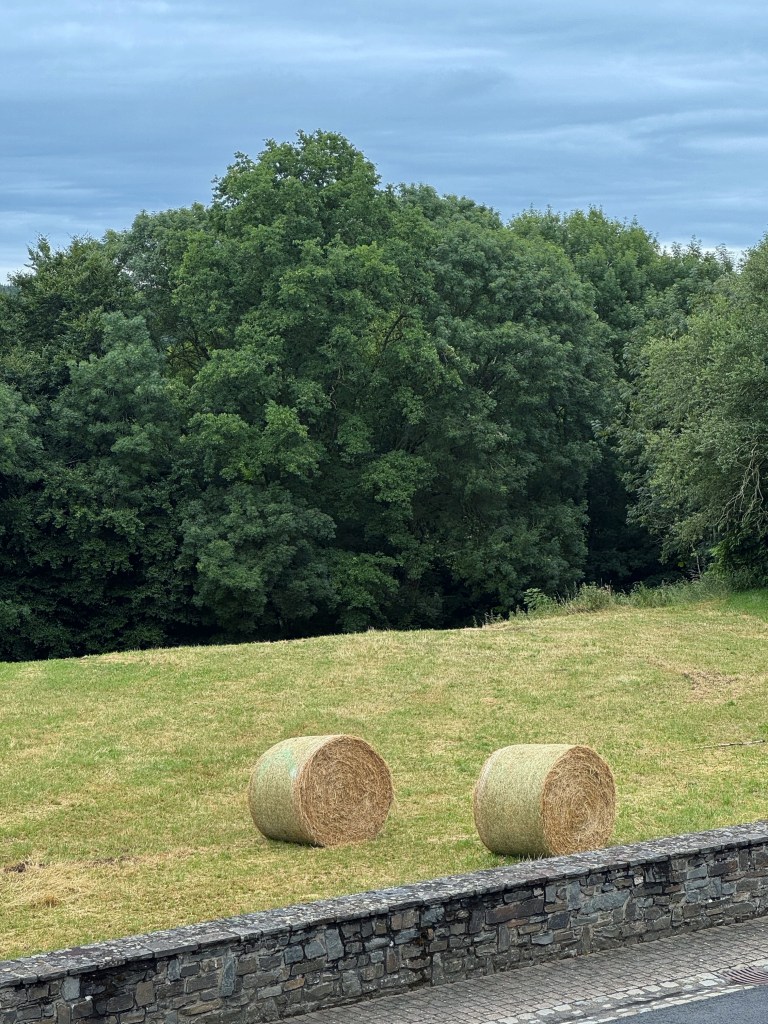
The photograph, above, was taken early this morning, outside my home in the Luxembourg Ardennes. It’s a peaceful place. It is also a refuge for families of migrants from Syria, Ethiopia, the DRC, the Philippines and other places of struggle and conflict. It is the home to a some French, German and Belgians whose countries border this small landlocked country, together with this one Guyanese and a hundred plus Luxembourgers.
However, eight decades ago, inhabitants in this tranquil countryside were gripped by fear, hunger and division. Whole families fled their homes in this and nearby villages, hid in these fields and forests and in makeshift underground bunkers. The farmland was overgrown and neighbours were wary of each other and their alliances. Much of the Western World, including the USA, rallied together at this attempt of erasure in WWII and later poured resources into rebuilding Europe.
At the same time, colonised countries of the Caribbean were all involved in the war effort; sending sugar, meat, dried goods, socks and scarves knitted under the tropical heat, to those in need thousands of miles away in places where few of us now are welcome. Women and children, the old and the sick were on the verge of starvation, here in Europe. Soldiers from nations, still under colonial rule, in the Caribbean, Africa, Asia and the Far East were all involved in supporting this struggle for peace and later in rebuilding towns, cities and countries. Now, 80 years on, in June 2025, we are not facing ‘history repeating itself’ but a newer and much more dangerous world.
This patch of land is what I see each morning. A small place in which birds move freely each day, where the deer hide from us humans, where millions of insects live their lives in community, where rain falls, sun shines and grass grows. This is the peace that lives outside my home, whilst inside I rage. This is a peace unattainable to those in Gaza; this attempt to erase all memory, all past, every photograph, every item of clothing, every building, every home, every possible idea that there is a nation; a people who exist. Those in South Sudan, Syria, the Ukraine, the DRC, Niger, Iran, Myanmar, Yemen, Ethiopia and Haiti continue to augment the UN figure of 305 million individuals in urgent need.
Sadly, wars are not only about the people, their homes, schools, hospitals and grave yards. Moreover, they are about power, economic control of resources and a deep belief in the superiority of one group over another. What emotions are we now composting in our children and grandchildren? What price are we willing to pay for peace? What will be the long-term price that we will all pay? The United Nations has called this ‘A World on Fire’ but what we are witnessing will become a legacy that will span generations.
Our words, our actions, our art, our music, across the world, continues to let leaders know that there is no way forward without peace. Seun Kuti offered a short message, this month, to the young people in Europe who clamour for peace.
As June comes to a close, I leave you with the words of Omar El Akkad, (and title of his book). El Akkad is an author and journalist, born in Egypt, spent his early years in Qatar and moved to Canada as a teenager. He now lives with his own family in the United States.
“One day, when it’s safe, when there’s no personal downside to calling a thing what it is, when it’s too late to hold anyone accountable, everyone will have always been against this” Omar El Akkad, 2025
 Patricia Angoy
what an inspiring peace on our world. The juxtaposition of the tranquility in our backyards with the raging conflicts in all these parts of the world lays bare the stark contrasts that humans face, everyday, every decade. What price do we pay?
LikeLike
So true Jackie. So many never get to experience this tranquility at any time in their lives. Indeed, what price do we pay?
LikeLike
These sentiments are so needed and timely. Thank you for posting and for reminders of El Akkad ‘s words. Free Europe! What a thought!!
Suzanne
LikeLike
Europe is so inextricably linked to all these conflicts. I am so grateful this thinking is being planted in our youth. Thanks so much for taking the time to share your comments Suzanne.
LikeLike
Thank you for your comments re the photo, Jackie. It seems to me that most of the world – including those unwelcome in Europe and the US – are paying the price for the peace and security of a tiny proportion of the world’s population.
It’s good to be constantly reminded of that!
LikeLike
“This is the peace that lives outside my home, whilst inside I rage”. Having such an observant eye is an unmatched skill. Like Jackie said, the juxtaposition is surreal . To echo James Baldwin in “Fire next time”, freedom needs work. And it is not work from the oppressed but the oppressor. Like the singer suggested, internal work is vital is ensuring that these cycles do not repeat. Free that and free that, outside your door is much easier than what is inside you or your heart. I like your saying that, there is peace outside your home, yet your heart aches. As always, thank you very much! What price do we pay?
LikeLike
Francisco, thank you for echoing the words of Baldwin. When we clamour for peace, it cannot be the work of the oppressed – how can it be? The struggle, as you so rightly point out, is inside of us and we are paying dearly. It is so hard for me to put into words what I feel, but that too is part of this internal struggle that you point to. Thank you for engaging with the work and for giving other readers the opportunity to do likewise, engage with you.
LikeLike
Great piece of writing Patricia! You are so insightful.
LikeLike
Dearest Anne, thank you so much for your comment, support and for being there!
LikeLike