
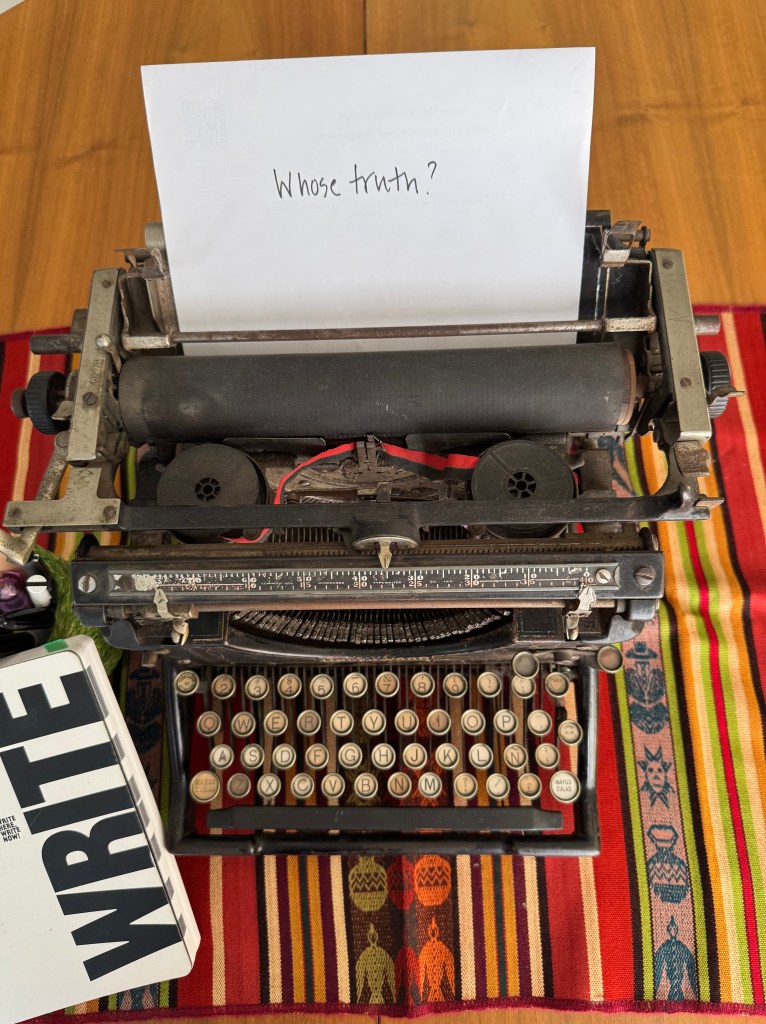
Author’s photograph, Jaime’s 1920 Underwood typewriter
Everyone has dreams and everyone has a story.
A wise Rwandan father would tell his children as they went to sleep; “At the end of the day, everyone has a story.” But most stories will never be heard. They are not written in books, nor shared in literary circles. They are not carried in local or global news outlets, wrapped into podcasts, or archived in databases. They are not whispered among friends, woven into coded messages or found scratched on walls. They are not told within the baskets of women working together or sung in skipping rhymes on hot summer days. They vanish into silence, unmarked, unremembered.
And yet, some stories break through because brave women and men, journalists, artists and truth-tellers risk everything to carry them across borders of power and indifference. Without them in their notepads, their cameras and recorders, how would we ever know the lives of children in refugee camps, the testimonies of women in war zones, the quiet losses of the elderly, the sick or the forgotten? Who would carry the dreams of those denied a platform, if not for the writers who reveal what powerful institutions would rather keep hidden?
Ida B. Wells (1862-1931) understood this over a century ago, when she fearlessly documented the violence and horror of lynching in the USA. She knew that silence protects perpetrators. She knew that truth, whether written, spoken or shouted is an act of defiance. Today, journalists in Gaza, Haiti, Sudan, the DRC, Ukraine and in other countless unnamed conflicts take up her legacy, documenting the violence occurring on every single continent, even as the world looks away. The price is steep. Every four days, a journalist is killed in pursuit of truth. Women journalists, increasingly on the frontlines, pay with their lives in growing numbers. And still, 85% of these murders are never punished. Impunity reigns and silence is enforced, (source: UNESCO digital library https://unesdoc.unesco.org/ark:/48223/pf0000391763 ).
What does that say about our world? Truth is fragile and deliberately endangered. Press freedom is not a luxury, it is a threat to those who profit from war, exploitation and inequality. The killing of journalists is not random. It is a weapon. It tells us that truth itself has become dangerous.
Edwidge Danticat, Haitian born writer living and working from the USA, reminds us of what is at stake. In “We’re Alone”, she asks haunting questions; What is left when you and your family are gone? Who will be a witness to our lives? I wonder who will see our dreams when we no longer rise from sleep? Colonial legacies and their modern mutations ensure that certain lives remain invisible, their stories unarchived, their dreams disregarded. Vulnerability, poverty and marginalization are not accidents but maintained structures.
I am often overwhelmed by the sheer volume of suffering. In this state of breathlessness, I return to the artists, the journalists, the relentless truth-tellers. They carve memory against forgetting in sculptures, manifestoes, photographs and billboards, in poems, in books, in films and plays. They weave truth into our lives and resist erasure by making us bear witness.
So, whose truth is it? It is the truth of governments, corporations or armies? Is it the truth of those who cannot afford to lie? The truth that outlives propaganda. The truth that unsettles the comfortable. The truth that refuses to be buried.
Whose truth?
 Patricia Angoy
Beautiful piece Patricia. Love your writing.
LikeLike
Thanks so much for reading and taking time out to comment. I really appreciate this especially when I know you are so full of work now.
LikeLike
Another wonderful thought- provoking piece, Patricia. I am grateful that you keep these truths at the forefront of our minds.
LikeLike
… and thank you for always reading them!
LikeLike
“They vanish into silence, unmarked, unremembered.” Everyone has a story, and most of the times, stories or narrative are what shape the world. Being able to connect a gadget in my hand with child labor in Congo, flushing 6 liters of water per toilet flush as compared to drought in South Sudan—shows the interconnectedness that stories matter. As always, thank you very much for sharing . It is always an honor to read your blog!
LikeLike
I am grateful for the connections you make for us, as readers, Francisco. Stories matter, indeed. Especially the thoughts and dreams of those most forgotten. Thank you!
LikeLiked by 1 person
So true. Feeling even more inspired to get back to my documentary visual storytelling. Thank you for your fresh perspective 🙏
LikeLike
So happy this piece inspires your own work. I am honoured.
LikeLike
Writing is in your blood Patricia. Bravo!
LikeLike
Thanks for the compliment from one writer to another.
LikeLike
I’m grateful to Barbara for sharing this post with me. It’s profoundly
sad that those with power are so bereft of compassion. It is
tragically ironic that all the excesses they possess nonetheless
leave no room for the needs of others. The inhumanity of their
actions reflects blind fear of their own diminished, impoverished
story and subjugation rather than liberation is the only choice they
perceive.
I appreciate not only your consummate writing skills but
more so the depth of awareness they represent. Thank you.
LikeLike
I too am so grateful for your contribution to this blog. I always appreciate it when readers engage with not only my writing, but that of others. I agree with you, totally, and hopefully we will all continue to benefit from your insights as I write and post this month’s blog. Thank you, thank you! Patricia
LikeLike