
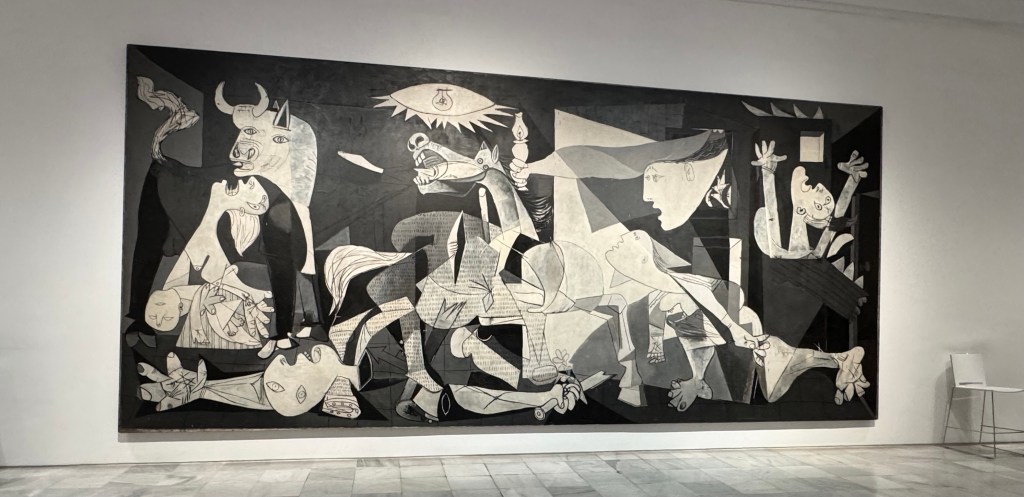
Author’s photo, September 2025: Picasso’s Guernica – Reina Sofia Museum – Madrid
I was hoping that the Nobel Foundation would decide not to award the Peace Prize this year but rather look deep into their souls, putting their list of names aside, and be courageous enough to honour the principle of Alfred Nobel in 1901; “for the greatest benefit to humankind”. I dreamed that they would make a statement that spoke to peace, worldwide. I believed, erroneously, that they would reach out to the citizens of this world, living in every single continent whose lives have been torn apart by conflict, poverty, war, genocide and the daily grind of waking each day to a situation that is worse than the day before, and offer to provide support for the people to carve out our own way forward.
It seems to me that the Foundation has made a statement that is an aberration of judgement that does not recognise this time in the world today in which not only is there an absence of peace but an erasure of basic human rights for those who most struggle to stay alive, one more day. The words of Kwame Ture (Stokely Carmichael 1941-1998) are as true today as they were when spoken.
“There’s a difference between peace and liberation”
When powerful individuals, multi-national mining companies, corrupt, imperialist governments and heads of state decide on the fate of nations across the globe, we cannot hope to gain peace in this world. The time has come to claim peace, as Pan African states, Non-Aligned governments, liberation movements and indigenous peoples around the world have done for centuries. How do we honour the sacrifices made by our elders and our ancestors if we do not actively support the new leaders of the world, most of whom have been silenced, exiled or imprisoned.
Let us be clear, there isn’t a lack of leadership in the world today but an overwhelming noise of those few who drown the hopes and dreams of many. The task to provide more than basic needs, is not an impossible one. It is achievable. Solutions abound on this Earth if we are willing to seek out examples, listen and take action. We have been solving our problems for many, many centuries. Great architecture, that is suited to the varied climate conditions, specific and changing across the globe, has provided homes. Medicine, grounded in indigenous knowledge supported by science is available to prevent and cure much of what now still kills children and adults can be administered freely if the mega drug companies forfeit their astronomical profits. Indigenous farmers have used their understanding of the changing and evolving climate, soil, crops, irrigation and harvesting to feed themselves and others, equitably. Education, the cornerstone of our societies, can promote community development and understanding, working, sharing and trading in partnership, as opposed to the exploitation of our countries rich in natural resources to benefit those who have already consumed their own.
This is not a plea for ‘peace and love’ across the world where it has been denied for centuries, but a real search for solutions, together. We cannot continue climb on top of the shoulders of those whose backs are already broken. Our leaders are not all dead. We do not have to constantly look on with anger. We can create our today. We can move forward with greater understanding of what and who is holding us back.
There are over 8 billion individuals on this planet. Surely, we can claim our spaces and places in this world. The Nobel Peace Prize is not our answer. So, what is holding us back from true liberation?
 Patricia Angoy
“…there isn’t a lack of leadership in the world today but an overwhelming noise of those few who drown the hopes and dreams of many.” This is such a powerful quote. What exactly is in the prize? and why the obligation of providing one every year even though, clearly there has been nothing in the world that warrants that? As I am writing this: Tanzanians and Sudanese are in the streets torching cars and people over elections and conflicts. Ivorians and Cameroonians the same. The world is in shambles and yet we are still prizing the prize. 8 billion people are surely a lot and deserve a better world than this. “We cannot continue climb on top of the shoulders of those whose backs are already broken”. This is such a well crafted phrase! The world’s system is sadly currently crafted to reflect that. How relevant is capitalism? and what does it mean and who truly benefits from it? is it fair for the very few to benefit while the majority are struggling? And what exactly is in that prize that they give out?
LikeLike
Francisco, I look forward to your insight and connection as I press ‘send’ each month on my blog. Thank you!
LikeLike
I’m either voicing this as someone who grew up in a third-world country, or as a chronically online millennial, or as someone who sees the Prize as an irony from the fact that Alfred Nobel invented dynamite, or maybe as a combination of all those: I view the Prize as something that has lost, not just its significance, but also its relevance.
As much as I frown upon the term “clicktivism”, I’m fully aware that I’m actively participating in it. It has become a part of my day-to-day life. The internet has made social activism more accessible, therefore giving us more exposure to “ordinary” people making “small” changes in their community. From Ibu Robin Lim in Bali to Greta Thunberg in Sweden, from a group of youth cleaning polluted rivers and beaches to a group of mothers donating food to support protesters.
I think, giving these people the spectacle and the platform, giving common people more power through a single click, creates a more open, egalitarian space for social movements. These efforts may be small, but incremental. They may not be on the radar of a Nobel Prize, but they show up and do the work. And like you said, we surely can claim our spaces and places in this world.
LikeLike
Anastha , thank you for highlighting these clear examples of some ways in which ordinary people are doing extraordinary work and so claiming spaces and opportunities for change.
LikeLike
I resonate with the quote that you mentioned that Francisco also noted. As I read through, I thought about one of the greatest leaders who had a wealth of wisdom King Sobhuza II of the Kingdom of Eswatini. He advocated for peace and unity and shaped behavioural culture in this manner. It is one of the qualities people will state about emaSwati
Thank you for the article and we pray for world peace and unity. Very reflective article indeed.
LikeLike
Thank you Celiwe. I often reference the wise words of King Sobhuza II. It was an honour to live among the emaSwati.
LikeLike
Fantastic Patricia
LikeLike