
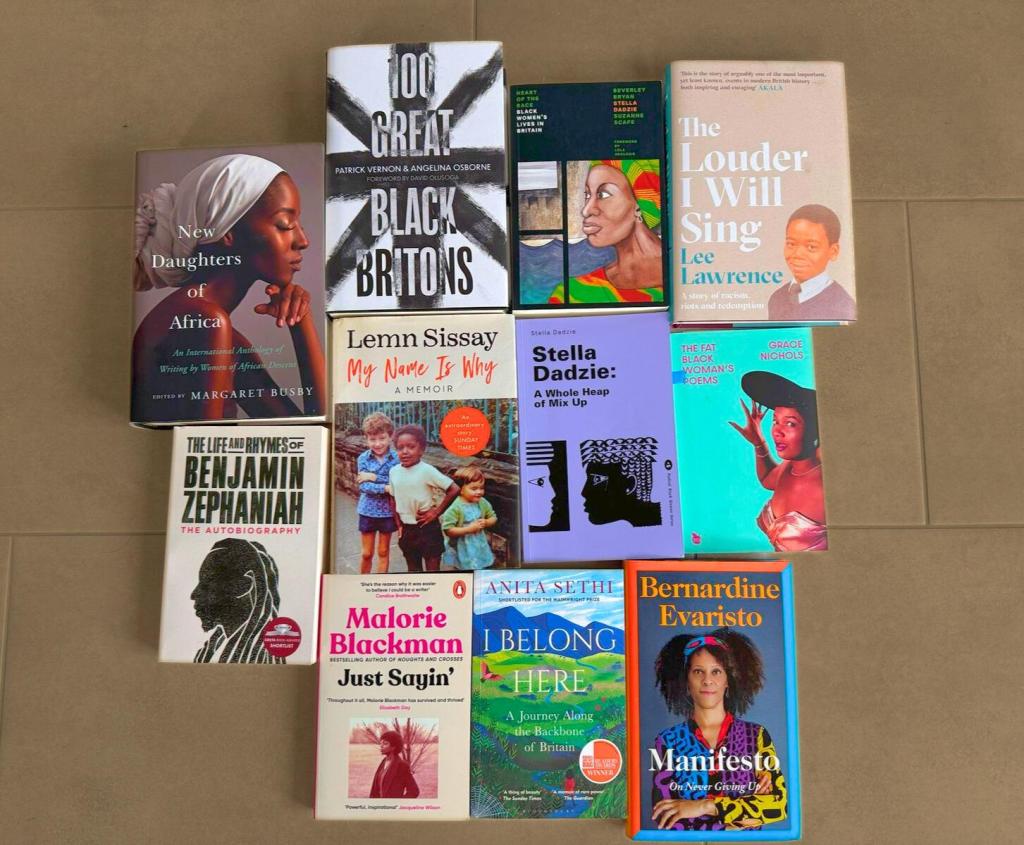
Some more reading material – author’s collection
As a young black woman in North London in the 1970s, the present looked bleak. The ‘SUS laws’, dating back to the Vagrancy Act of 1824, were in force. Black and other minority groups were stopped, searched and arrested on the suspicion of loitering, or on the assumption of the intention to commit a crime, with absolutely no evidence or proof. Police station jails, borstals and prisons were disproportionately filled with innocent people of African and Asian descent. Skinheads on the streets of the East End of London created terror and pain. As a newly qualified teacher, and the only woman of colour in my school, I was accompanied at the end of each day to the bus stop, where the white headteacher waited with me to safely board the London bus that would take me home to Harringay in North London. I was one of the lucky ones.
We protested as teachers, as residents, and as black women in our various organisations across the country. We wrote to our MPs, we voted, we created newsletters, pamphlets and distributed information about the new immigration laws, health, housing and employment rights. Churches, meeting halls, council estates, town halls and parliament buildings were all areas in which you could find us; Black women and men with our children. Horrific events unfolded on the streets of London, Bradford, Manchester, Cardiff and in quiet streets, in homes, in police stations and in Her Majesty’s Prisons. The 1960s, 70s and 80s were years in which growing up black in Britain was epitomised in the dub poetry of Linton Kwesi Johnson. Sounds familiar?
So, if this was the backdrop to memories of half a century ago, how can I be optimistic? The experiences led to greater understanding, self-knowledge, a collective call to action and sisterhood. Our enduring support of each other led us to envision the future that was constructed against all efforts from the establishment to destroy families, relationships, employment opportunities, homes and neighbourhoods. Poets, visual and performing artists created spaces for their work to be heard and seen. Black politicians, elected to parliament, gave voice to what was happening across the country, as actors, writers, newscasters and teachers, factory workers, health workers and transport employees together with the unemployed, continued the work for change. Stella Dadzie’s latest book published in October 2025, A Whole Heap of Mix Up shares more details about this time, and other moments through her life, and that of other British Black sisters. https://lwbooks.co.uk/product/stella-dadzie-a-whole-heap-of-mix-up
I believe that change, albeit piecemeal and erratic, was only possible because a more optimistic future was envisioned in a present that seemed impossible. The struggle is never easy and we witnessed and experienced great loss along the way. The lives of women of African and Asian descent, indigenous women and their families are still under threat but now much more visible. Young black women writers of both fiction and non-fiction are making their voices heard and the stories of our people, of all genders, more accessible. The twenty-year olds of 50 years ago are still envisioning and struggling for a different, more optimistic future.
When it may seem impossible, what optimistic futures can we create now?
 Patricia Angoy
What optimistic futures can we create now? I am a little bit ashamed to say that I now avoid thinking about the future, and can’t (won’t) envisage it. Its too painful, given what’s going on today, going on despite our memories of the past, and despite experience and instinct saying all this – thats going on now – is all wrong. I try to soothe myself by telling myself, regularly and often, that it’s the small acts in the present that matter, and that the future is not worth worrying about. My partner, Peat, says its simple. One should just “enable people, especially children, to grow things and play musical instruments together.” Maybe he is right.
LikeLike
but isn’t it precisely the fact that the present is so awful that we must envision and work towards a different way? You do that everyday. I know. Your animals, the earth and all that surrounds you, greet you each new day with gifts. Much love, P
LikeLike
I have been thinking about this. Its not that I am utterly without hope for the future. Its just that I am averse to thinking about it in those terms… in terms of trying to visualise something… because the future is such a mysterious thing. Actually anything could happen. I feel that envisioning a future from my present perspective will always be inadequate to the future (which is necessarily always so much bigger, and different from the present within which we envision it). So I tend to focus more on the present: on what my past, what my memories (which constitute my being, in fact) can bring to it. I trust that if I am care-full with the present (respectful to all it contains) then the future (in general, not just mine) is going to be a bit better off for it. Our acts in the present coalesce to generate an unimaginable future. I am sure things that are both respectful AND disrespectful coalesce in exactly the same way, and maybe that’s what bothers us so much about about the future: we become afraid of the huge, unknown, ugly thing that many disrespectful actions can create through their coalescence. And we forget that we can create positive coalescences too. Although we still can’t know what things this will produce. So… I think my answer to you is that its possible to use our memories to co-create a respectful present… one that has some real power to counter (even if it can’t stop) all the disrespectful shit that’s currently going down. Thats probably about as optimistic as I am capable of being.
LikeLike
It is very challenging to envision the future. Sometimes I feel like e go backward. People make progress, and on the other side, people are working hard to tear that down! Our predecessors have surely worked hard for our present–even though it is bleak! Our memories of the world, 70s for England, 60s for USA and all oppressions of various forms that has targeted people of color. I overhear people glamorizing the past, “Long time things were better” and one can’t point to the exact point! We however have to continue believing that the future of peace and happiness is possible! As always, thank you very much for sharing!
LikeLike
As difficult as it may be to envision a better future it is this possibility that makes the present moment one to live as fully as I can. Thank you, always, Francisco for your engagement.
LikeLike
Patricia, A remarkable essay, which enlightened me about a period of history I know very little about. The SUS laws! The long shadow of old laws. I love how you use the example of your personal experience to make a broader point about the case for optimism. Well done!
Linda
LikeLike
Hello Linda,
Thank you for your comment and support. It is incredible how old laws that have not been repealed can come back to haunt us!
LikeLike
Patricia, This video knocked me off my feet when I first watched it a few years ago. I found it after reading her book. Her message and profound articulation of rage is irresistibly moving. https://www.youtube.com/watch?v=llci8MVh8J4
Another (British) author that has been instrumental in what I hope is my ongoing development is Layla Saad through studying her book, Me and White Supremacy. Her end-of-chapter questions were whacks upside the head, and heart, for that matter.
These two resources have been inspirational enabling any small part I might play.
HabitShift Larry Birckhead (778) 628 – 9470 http://www.habitshift.com
We become that which we repeatedly do. Excellence, then, is not a single act but a habit. ~Aristotle
>
LikeLike
Thank you Larry for sharing such a powerful video that I hope everyone can watch and understand the history of why things are the way they are in the world, and especially in the USA and Europe where the wealth accumulated over the last 450 years has been built on the backs of others from former colonies. It is so great that you can share resources with us all. Thank you
LikeLike