
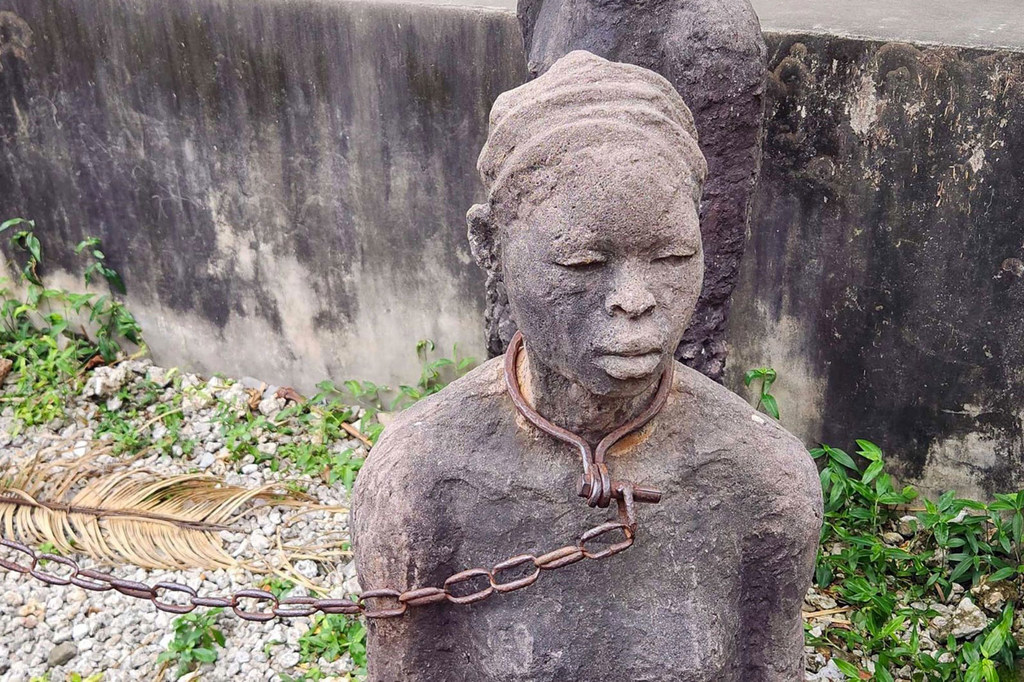
Source: UN News. Kumbukumbu Ya Historia Ya Watumwa – A slavery memorial in Stone Town, Zanzibar, United Republic of Tanzania
James, the title of this month’s read at the Panafro Book Club created much discussion, critique, and questioning both to each other and deeply inwards. More than twenty of us sat around a large table at the back of a coffee shop/restaurant during their slow period, in the early Saturday afternoon. The main city square, market place and the Grand Duke’s palace were all just outside the door. Inside this eclectic group of readers grappled with the savagery, inhumanity, bigotry, power and gain within the pages of James. They are all too close to our world in 2026. The novel is full of ironic beauty, despite Percival Everett’s construct of the mid-1800s, when reading the most cruel forms of punishment, inflicted on the bodies of children and adults alike, made me flinch with each blow. Yet there is power in the determination of one man to return to what is most loved, most cherished and reclaim who he rightfully is; James. His full name.
https://www.instagram.com/the.panafro.bookclub/
And our names can carry weight, signal ancestry, bondage and appropriation. They can also hold deep meaning, connection and responsibility. They often signal times past and carry hope into the future. They signal place, time and possibility. But within all this, they signal identity and the fullness of our being. When we are re-named, our past story is erased and another, superimposed. Mark Twain’s Jim, is not James.
Earlier this month I went to see the documentary The Marbles which debates the return of the Parthenon Marbles to Greece, often referred to, erroneously, as the ‘Elgin Marbles’. So how does Elgin own something that was never his to own? And why does the British Museum house stolen artefacts, religious icons, sacred pieces, human remains and other looted works of unimaginable value? And how is it that the greatest number of visitors to the British Museum are not British, but come from, or originate from places all over the world, to view stolen pieces from their own countries, religions or ancestry? They do not belong there. The film director’s proposal is that the British Museum, as its name indicates, should only house objects that are British. The implications are huge.
https://www.guerilla-films.com/the-marbles
“There are spirits of the victims of slavery present in this room at this
very moment, and they are listening for one word only: Justice”
Esther Philips, First Poet Laureate of Barbados
The complete poem was delivered by Esther Philips in the UN Assembly Room. https://www.facebook.com/reel/1456224035879707
Her poem was read in person at this historic moment, on 25 March of this year, when 123 member states voted in favour of adopting the resolution to declare the transatlantic slave trade as “The Gravest Crime Against Humanity”. Slavery, created the wealth and the continuing prosperity and power for the 53 states, who abstained. Three nation states voted against; Israel, the USA and Argentina. Therein lies much more than the vote.
Enslavement and its trade, continues to be the gravest crime against humanity. Its name reverberates in my mind, in my heart and in my soul. Its legacy, is our struggle.
What are you holding in a name?
 Patricia Angoy
❤️
Ela Bichler Owner Salt! Luxembourg http://www.saltluxembourg.com
LikeLike
A name? There is so much to speak about here! There is so much to the world as it is, but how we see it, was decided for us by our colonialists—100%. For example, a few days ago, my girlfriend explained to me how they decided what is a fine and folk art. Every art that was not from Europe or North America was considered folk. Art worth is mostly determined by the narrative and fame behind the artist, at least that is what they have made us believe. What happens when that narrative is defined for us by someone else? Time [determined by UK GMT], culinary systems and syllabuses [French restaurants], academics, literature is Shakespearized… Of course we had and still have a name, but a name goes along with power. Sadly most none western names, even those powerful ones [grandparents in villages passing on their oral history before they pass on] are ‘required’ to write it down so it gets validation. Wait, only if it is written in a language [their grammar, their rules, their tone] that they decide.
As always, I am forever grateful for your Wisdom Patricia!
LikeLike
Francisco, I really appreciate how you invite us into discussion from my blogs. You make us think and see one perspective, mine, from another. How grateful I am to you. Thank you!
LikeLike
Dear Patricia,
So powerful! I read *James *last year and was moved by the code-switching as James was forced to shift between his humanity and how enslavers perceived him. I’m reminded of the famous line from Hamilton: “Who lives, who dies, who tells your story?” Telling our stories in full is an act of defiance and a corrective to history.
Of course, the current US administration would erase our stories and our humanity. I was glad to see more of my fellow Americans on the march this weekend, but It is to our everlasting shame that Trump was ever elected in the first place. It is a great humbling for a once arrogant nation. There is no going back to what was, and the future remains unknowable.
LikeLike
Dear Linda,
Thank you for sharing your comments with our readers. It is so true that in order to live, we must tell our stories, otherwise someone else may do so!
When you threaten, people then say enough, and all over with world we are saying “Basta!”
LikeLike
Thanks for these powerful reflections. This UN vote was so important. It opens up new pathways of legitimacy to teach the truth of this story to middle and and high students.
LikeLike
Thank you, Elijah, for engaging with the blog. You are so right. The UN vote is the catalyst for the long road ahead.
LikeLike
Thank you for these powerful reflections. This UN vote was a big deal. It opens up new pathways of legitimacy to teach the truth of this story to middle and high school students.
LikeLike
Hi Patricia,
I trust you are having a good Easter weekend. We are currently in Zanzibar for an extended Easter break, and yesterday we visited Stone Town, including the former Slave Market. It is difficult to adequately articulate the emotions evoked by being in that space and learning about the atrocities endured by those who were enslaved. The experience was a sobering reminder that, while slavery may have taken different forms over time, it has not been entirely eradicated and continues to exist today in varied and often subtle ways.
Thank you for your piece.
Warm regards
Sibongile
LikeLike
Hello Sibongile,
Thank you so much for your personal account of the visit to Stone Town and the former Slave Market, in Zanzibar. It must be so much more impactful being on the site of such atrocities in history; ones that I carry close. But … as you so rightly point out, there is so much more to do. Eradication of the bondage of enslaved people, wherever they exist, and for me, a continued process to dismantle the legacy of slavery through restoration and reparation, education, the revival of memory. There is so much work to do!
Take care and stay in touch.
Warm regards,
Patricia
LikeLike
Dear Patricia,
What a coincidence, my book group here in the south of France has been reading James too! I shared with them your link to the moving words of Esther Philips, for which they are most appreciative.
We agreed that while parts of James can be a harsh read, it is undeniably evocative in its reminder of the power of language , and names in particular. While the nature of any concept or perosn exists independently of its name, names still matter for good or ill. From our earliest years we feel unrecognised when others refuse to say our name correctly, and cowed when a bully ‘calls me names’. I feel for the young people in todays world who believe that the need to ‘ change my name on my CV to give me a better chnance of being offered an interview.’ Language shapes the mind and shapes reality; it’s an effective alternative to brute force.
On my fridge sits my favourite magnet, bought from On the Seam museum lying on the line between east and west Jerusalem. It states: The beginning of wisdom is to call things by their right names.
{a comment from Tricia Herbert}
LikeLike