
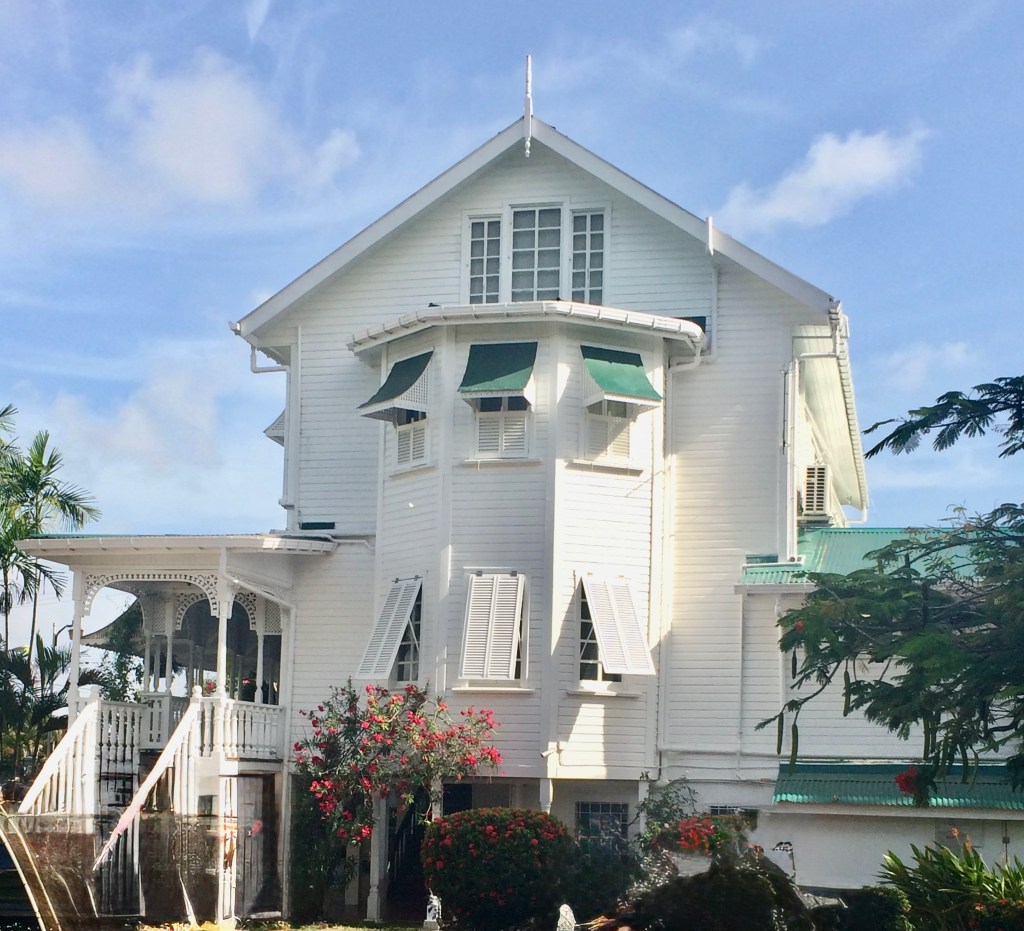
Author’s photograph: Peter Rose & Anira Streets, Queenstown, Georgetown, Guyana.
The nuns busied themselves trying to learn as much as they could about a country that was, like sand, fast slipping through their fingers. They were a group, of many, who ardently preserved the last bastions of British colonial rule in our country. I was indifferent to their lessons on the history and geography, literature and science of the mother country. I could recite from their watercolour illustrated books with blonde women in floral dresses, belted at the waist with flowing skirts sitting under the shade of oak trees. I could sing the psalms, by heart, in the cool of the chapel every Friday morning, and run the egg and spoon race on sports day.
I was ten years old and more interested in catching tadpoles with cupped hands from the alley behind our house, buying red and yellow cones from the ‘shave-ice man’ on the corner of Peter Rose and Anira Streets, buying pholourie balls for a few cents, dripping with sour and wrapped in brown paper, from the ladies who sat under the shade of their large black umbrellas with wicker baskets covered in white linen table cloths near our school gates. When no one was looking, I would slip into the corner shop on my way home to drink ginger beer at the counter whilst swatting flies and crunching ants. We, both human and non-human, fought to get a taste of the sweet sharpness from those brown bottles that cooled in the shade along the wooden shelves.
This was a childhood, lived at the margins of the political turmoil of the 1950s and 60s, in one of the wooden houses on stilts, with whitewashed panes and large jalousie windows that gave shade from the afternoon sun that melted the tarred macadam outside, and bleached the white sheets on clothes-lines behind our house. Riding my bicycle home, a hand-me-down from my third sister, I could catch the breeze from our muddy coastline, peddling fast as fast as I could to then take my feet off the pedals and jump into the bicycle seat, still too high for my 10-year-old pins and knobbly knees with their roadmap of scars.
Independence in Guyana was happening and the nuns were obliged, by government orders, to suspend their colonial texts for those of a new nation that dropped the British and changed the spelling of our indigenous name meaning ‘land of many waters’. I learnt a new national anthem, a coat of arms that I could recognise and knew the significance of each colour on the arrow-head flag that replaced, among other vestiges of colonial rule, the Union Jack, pounds, shillings and pence and finally Elizabeth’s portrait. She shifted a little to the right, as we remained part of the Commonwealth of Nations, to make room for L.F.S on the left. Both were proudly displayed in the entrance to St. Gabriel’s Primary School at the Convent of the Good Shepherd. My school, for over seven years at the time.
At midnight on the 26 May, 1966, I held on tightly to my aunt’s hand, since my parents were part of the official ceremony, the other hand waved enthusiastically on seeing our new flag raised to the roar of a euphoric crowd of fervent Guyanese; all of us together it seemed; “One People, One Nation, One Destiny”. Silence fell, briefly, as we stood attentive to the drum roll that introduced the first bars of our anthem, “Dear Land of Guyana …” before we all burst into song, cheering and hollering to drown out the waves that crashed against the seawall; our hearts beating, briefly, as one. I stood small; a proud Guyanese. That night I never imagined that I could live anywhere else than on that land “of rivers and plains, made rich by the sunshine, and lush by the rains, set gem-like and fair, between mountains and sea, your children salute you, dear land of the free”.
It had taken centuries of resistance, enslavement, rebellion, murder, extraction and appropriation, union strikes on plantations and in mines, negotiations, talks and walk-outs, suspension of our constitution by the Crown together with continuous forced division to get to this moment, 60 years ago. What did it mean to become an independent nation in 1966, eager to break the shackles of the previous 400 years? I struggled to understand its significance but I knew that something important was shifting in my immediate environment. I was too young to comprehend its magnitude, or envision what would unfold in the years ahead. I was ten years old and not cognisant of the struggle that lay ahead.
Where were you at ten?


Love this Pat. At 10 my consciousness was still dormant. It would be 3 years later that I woke up to what apartheid really meant
LikeLike
10 was a magical age for me. Into the double digits! Thanks for sharing your own journey into consciousness
LikeLike
A beautiful and thought-provoking piece. At 10 years I was roaming the fields and woods of my family’s dairy farm in the South East of England. It was not until decades later that I learnt about the privileges this afforded me, and about how my grandfather’s part in the colonial, capitalist machine enabled him to buy the farm in the first place.
LikeLike
… but in the meantime you enjoyed the farm and live to understand its significance. Thanks so much for sharing these thoughts with us all, Fran. Greatly appreciated.
LikeLike
Reading this blog, was a peep into your life! At 10, I was a in a refugee camp in Malawi and one of friends had just died from Cholera. About a kilometer in the north, a house had just been set ablaze because the owner was a Tutsi. Congolese only played with Congolese. Burundians with Burundians. And Rwandans ONLY with their families. Two of our church mates got selected for WUSC [World University Service of Canada] and both their lives had just changed or received light! At 10, I was half naked and ambitious!
LikeLike
Oh Francisco! You must have such a strong family to have protected you and steered you towards the path you now follow. I am grateful that this path also crossed mine. Who would have believed that to be possible?
LikeLike
At 10, I was deeply rooted in British Guiana, never imagining I could possibly live anywhere else. It was my land and I was proud to live there. Enjoying the freedom associated with climbing a plum tree, laying in the nook of a limb with a book and observing all below. Bliss! Or playing cricket with the boys, when they let me. Or Jack’s, on my own with my pretend friends. Could anything be more wonderful than this?
LikeLike
Nothing beats this! Thanks so much for sharing a peep into your childhood Barbara. We must have a game of jacks when next we’re together. I’m sure you’ll still beat me!
LikeLike
Oh Patricia, this is so lovely. I felt I was with you every step of the way, taking in all the sights and sounds. Age 10 was a glorious year–still a tomboy, scabs on the knee, running wild the way you still can as a child, before anyone chides you to “act like a young lady”. And I was writing for myself for the first time, in a notebook that I refused to call a diary.
LikeLike
So grateful for your comment. I agree that at 10 many of us were still children before the changes in our bodies moved swiftly from little girls to young women. These were precious years, indeed. So you were already the writer then and still. Fabulous!
LikeLike
Qué relato histórico qué vivencias,muy significativas para ti tambien para el país. El ser un país independiente .Todo nuevo pero igual
Me encanta y te admiro ,como relatas ,como cuentas lo vivido
Recordé hace poco que el año 1966 fui a Santiago con mi familia ,tambien tenía 10 años y fuimos a conocer un mural recien inaugurado en el paseo Juan XXII, en Ñuñoa realizado por el Muralista Gregorio de la Fuente ,que estaba casado con la hermana mayor de mi papá, y recordé el hecho porque hace 2 senanas se realizó la reinaguración ,después de haberlo restaurado . Un gran abrazo querida amiga
LikeLike
Gracias Lirayen por tus comentarios y también por recordar tu pasado que ahora se hace presente! Gracias por nuestra amistad, y gracias por traducir y leer mi blog. Un gran abrazo desde lejos.
LikeLike
Hola Lirayen, Tendría que ver el mural la próxima vez que me encuentro en Santiago. Mi admiración siempre va hacia ti. Gracias por nuestra amistad, siempre Patty.
LikeLike